2025-09-12 ラトガース大学
<関連情報>
- https://www.rutgers.edu/news/when-it-comes-breastfeeding-study-shows-timing-important-consideration
- https://www.frontiersin.org/journals/nutrition/articles/10.3389/fnut.2025.1618784/full
母乳の生物活性因子と微生物叢の日内変動
Day/night fluctuations of breast milk bioactive factors and microbiome
Melissa A. Woortman,Haipeng Sun,Jincheng Wang,Filipa Godoy-Vitorino,Angeliz J. Rivera Meléndez,Maribel Campos Rivera,Edna E. Aquino Piñero,Krystin Engelhardt,Lawrence C. Kleinman,Maria G. Dominguez-Bello
Frontiers in Nutrition Published:05 September 2025
DOI:https://doi.org/10.3389/fnut.2025.1618784
Introduction: Human breast milk is a sophisticated and complex biological fluid that provides crucial nutritional, immunological, and microbial benefits to infants. Hormones exhibit circadian variations in maternal serum, and understanding these fluctuations in breast milk is crucial for assessing infant maturation. This is particularly relevant when expressed breast milk is fed at a different time from when it was originally produced.
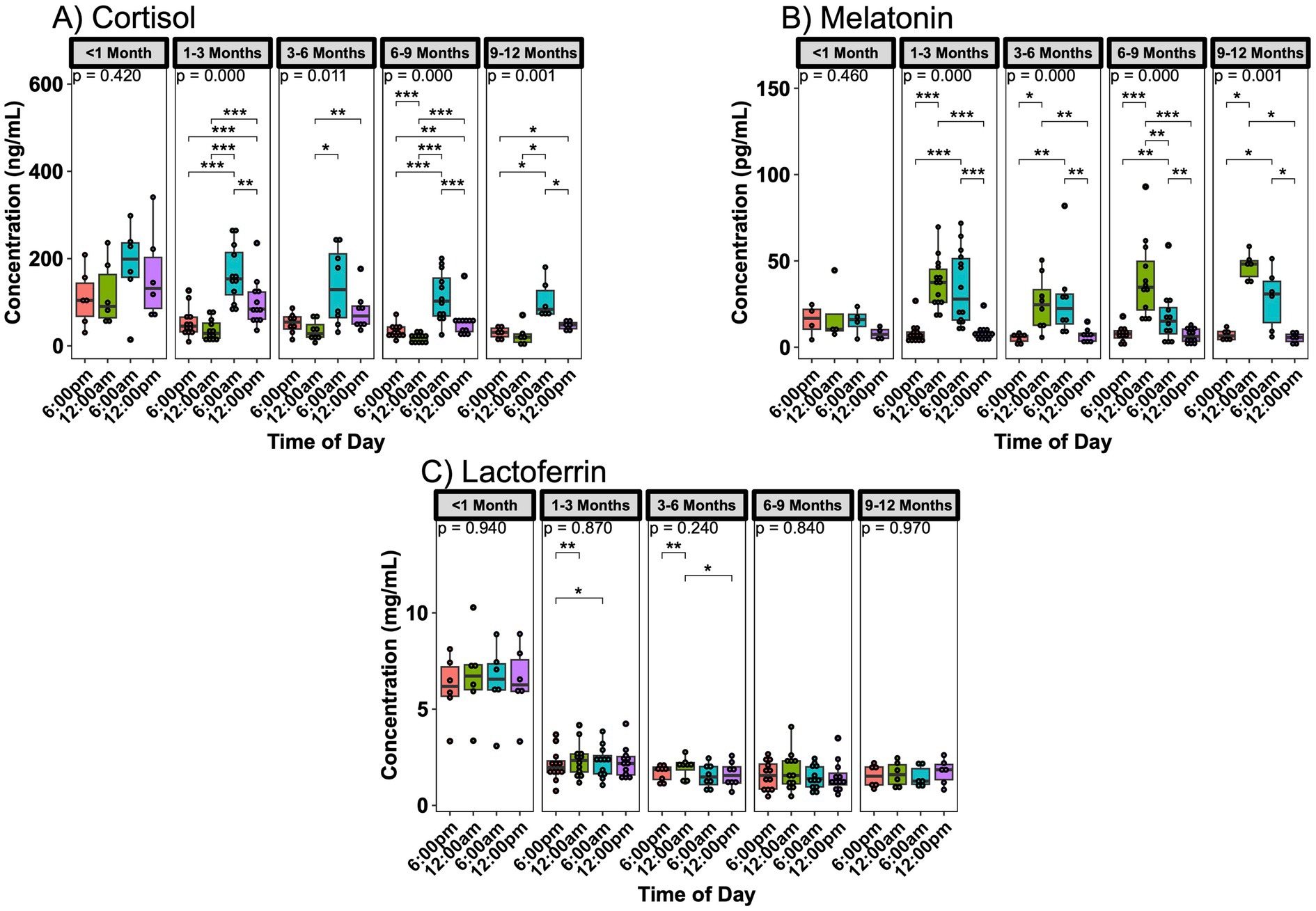
Methods: This study examined 24-h variations in breast milk composition by analyzing samples from 38 lactating mothers at four distinct times of the day. Levels of cortisol, melatonin, immunoglobulin A (IgA), lactoferrin, and oxytocin were quantified using ELISA, and microbiome composition was assessed through 16S rRNA sequencing.
Results: Significant 24-h fluctuations in melatonin and cortisol concentrations were noted, whereas lactoferrin and IgA levels only varied when separating by infant age, maternal BMI, or infant sex. Breast milk microbial composition shifted, with a nocturnal increase in skin-associated bacteria and a diurnal increase in environmental bacteria depending on maternal BMI and infant age. Additionally, milk microbiota alpha diversity increased due to age, but not consistently over all the time points.
Discussion: These differences in 24-h breast milk composition underscore the physiological relevance of maintaining the natural temporal dynamics of breast milk, which may be disrupted when expressed breast milk is fed asynchronously from its time of expression.