2025-10-10 中国科学院(CAS)
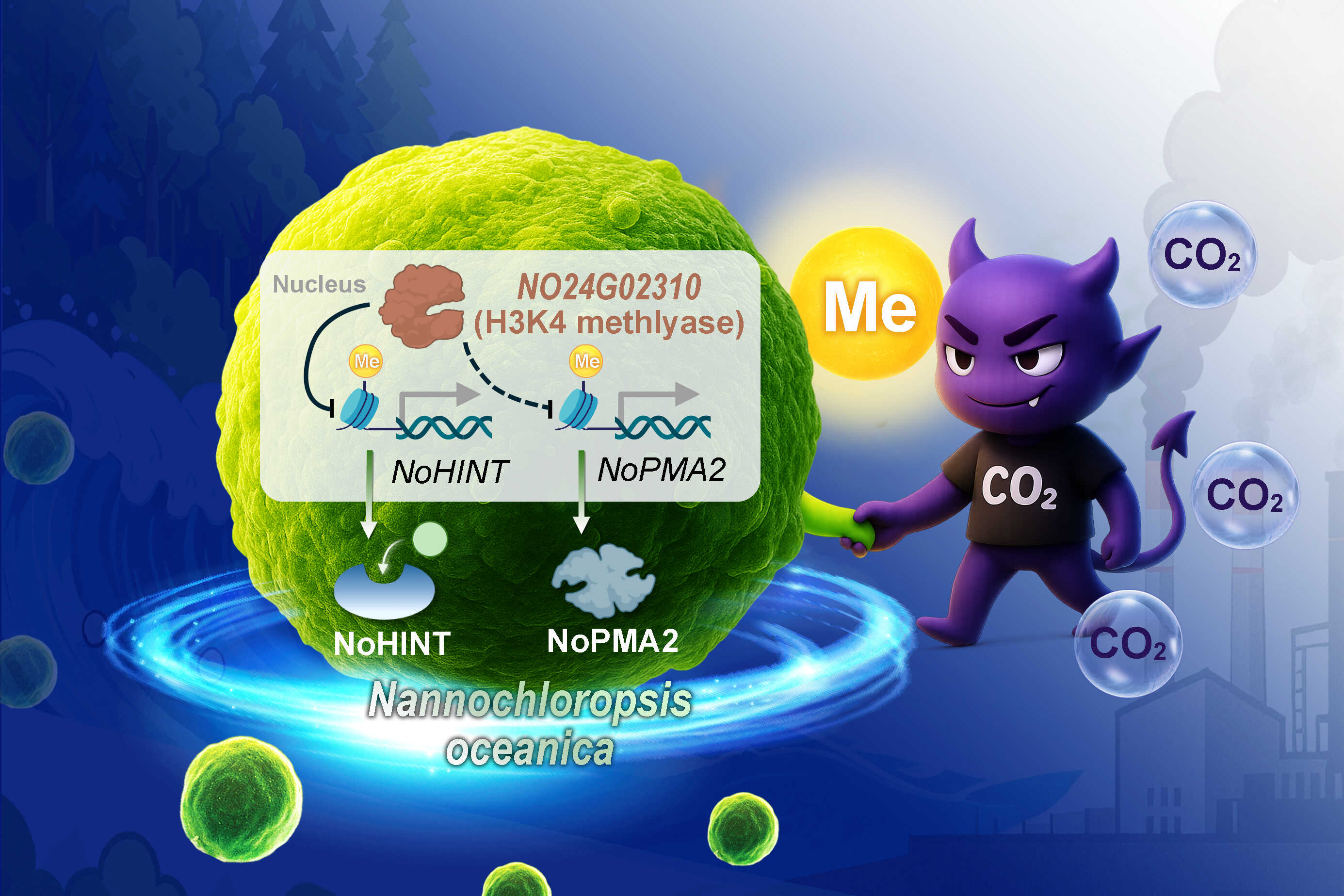
H3K4 histone modification mediates low-CO2 adaptation in Nannochloropsis: (Image by QIBEBT)
<関連情報>
- https://english.cas.cn/newsroom/research_news/life/202510/t20251010_1089023.shtml
- https://www.sciencedirect.com/science/article/pii/S2590346225002962
- https://www.cell.com/plant-communications/pdf/S2590-3462(25)00296-2.pdf
多次元エピゲノムダイナミクスは、Nannochloropsis oceanicaにおける低CO2適応のH3K4制御に収束する Multi-dimensional epigenomic dynamics converge on H3K4 regulation of low CO2 adaptation in Nannochloropsis oceanica
Yanhai Gong, Qintao Wang, Li Wei, Lianhong Wang, Nana Lv, Xuefeng Du, Chen Shen, Yi Xin, Luyang Sun, Jian Xu
Plant Communications Available online: 25 September 2025
DOI:https://doi.org/10.1016/j.xplc.2025.101534
Abstract
Despite their ecological and biotechnological importance, whether and how microalgae are regulated by epigenetics have remained poorly understood. In the model industrial microalga of Nannochloropsis oceanica, by comprehensive, multi-dimensional epigenomic analyses, we uncovered an epigenetic regulatory mechanism in response to CO2 level that involves the complex interplays among DNA methylation, histone modifications, dynamic nucleosome positioning, and 3D chromatin structure during low CO2 adaptation. Despite minimal DNA methylation, histone modifications including lysine acetylation, crotonylation, and methylation were associated with active chromatin states, and linked to 43.1% of the differentially expressed genes. Notably, histone H3K4 di-methylation (H3K4me2) exhibited a distinct dual-peak profile around the transcription start site, and is linked to dynamics of chromatin compartmentation. Knockout of NO24G02310, a candidate H3K4 methyltransferase, resulted in genome-wide H3K4me2 peak shifts and a decrease in H3K4me1 levels, accompanied by direct or indirect downregulation of NoHINT and NoPMA2 expression, slower microalgal growth and reduced photosynthesis (indicated by Fv/Fm), specifically under low CO2 conditions. Deletion and overexpression of the histidine triad nucleotide-binding protein of NoHINT and the plasma membrane H+-ATPase of NoPMA2 revealed the two enzymes’ roles on growth and photosynthetic efficiency under low CO2, with NoHINT regulating growth and NoPMA2 influencing photosynthesis. Thereby, as a previously unappreciated strategy of low CO2 adaptation, NO24G02310 may coordinate the regulation of NoHINT and NoPMA2 through the participation of H3K4 modifications. These findings lay the foundation for enhancing microalgal productivity through epigenetic engineering.