2025-10-17 マサチューセッツ工科大学(MIT)
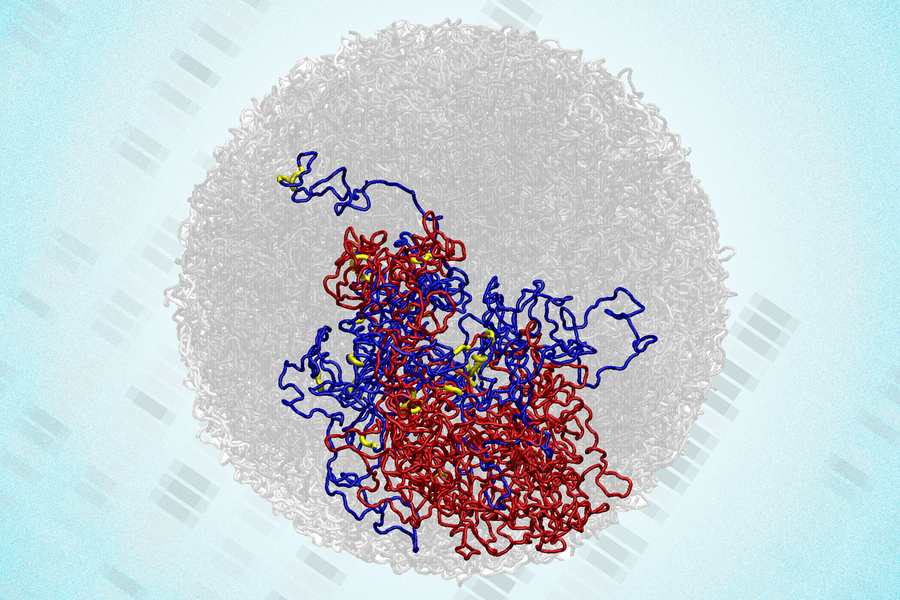
MIT experiments have revealed the existence of “microcompartments,” shown in yellow, within the 3D structure of the genome. These compartments are formed by tiny loops that may play a role in gene regulation.
Credit: Ed Banigan, edited by MIT News
<関連情報>
- https://news.mit.edu/2025/surprising-discovery-scientists-find-tiny-loops-genomes-dividing-cells-1017
- https://www.nature.com/articles/s41594-025-01687-2
- https://medibio.tiisys.com/110688/
有糸分裂からG1期への移行における微小コンパートメント形成のダイナミクス Dynamics of microcompartment formation at the mitosis-to-G1 transition
Viraat Y. Goel,Nicholas G. Aboreden,James M. Jusuf,Haoyue Zhang,Luisa P. Mori,Leonid A. Mirny,Gerd A. Blobel,Edward J. Banigan & Anders S. Hansen
Nature Structural & Molecular Biology Published:17 October 2025
DOI:https://doi.org/10.1038/s41594-025-01687-2
Abstract
As cells exit mitosis and enter G1, chromosomes decompact and transcription is reestablished. Hi-C studies have indicated that all interphase three-dimensional genome features, including A/B compartments, topologically associating domains and CCCTC-binding factor loops, are lost during mitosis. However, Hi-C is insensitive to features such as microcompartments, nested focal interactions between cis-regulatory elements. Here we apply region capture Micro-C to mouse erythroblasts from mitosis to G1. We unexpectedly observe microcompartments in prometaphase, which strengthen in anaphase and telophase before weakening throughout G1. Microcompartment anchors coincide with transcriptionally spiking promoters during mitosis. Loss of condensin loop extrusion differentially impacts microcompartments and A/B compartments, suggesting that they are partially distinct. Polymer modeling shows that microcompartment formation is favored by chromatin compaction and disfavored by loop extrusion, providing a basis for strong microcompartmentalization in anaphase and telophase. Our results suggest that compaction and homotypic affinity drive microcompartment formation, which may explain transient transcriptional spiking at mitotic exit.