
2025-11-03 イリノイ大学アーバナ・シャンペーン校
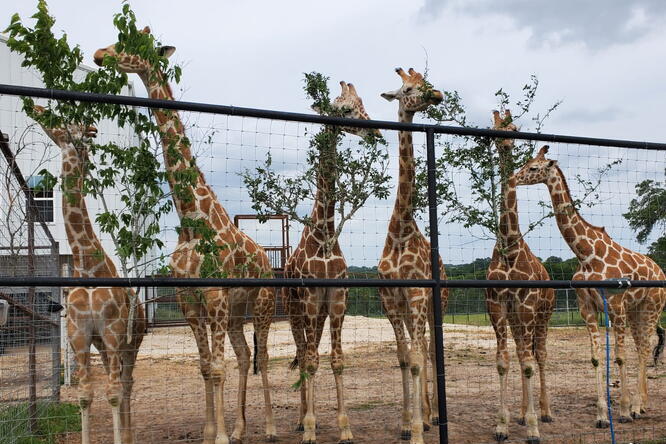
New genomic research shows widespread hybridization among North American giraffes in zoos and private ranches, diminishing their conservation value. Credit: Kari Morfeld.
<関連情報>
- https://aces.illinois.edu/news/wild-giraffes-lose-their-conservation-safety-net-zoo-populations-hybridize
- https://academic.oup.com/jhered/advance-article-abstract/doi/10.1093/jhered/esaf089/8303895
北米のキリンコレクションにおけるゲノム評価が保全の課題を浮き彫りにする Genomic Assessment of Giraffes in North American Collections Highlights Conservation Challenges
Wesley C Au, Kari A Morfeld, Christopher J Fields, Yasuko Ishida, Alfred L Roca
Journal of Heredity Published:27 October 2025
DOI:https://doi.org/10.1093/jhered/esaf089
Abstract
Recent genomics research has redefined the taxonomy of giraffes (genus Giraffa), identifying four distinct species rather than just one. This new understanding raises concerns about the ancestry of North American giraffe populations in human care (ex situ) and whether they still serve as meaningful conservation assurance populations for wild giraffe taxa. To address this, we performed whole-genome sequencing and analyses of 52 giraffes kept ex situ across North America, comparing them to wild giraffes representing all four recognized species. The analyses—including principal component analysis, admixture estimation, local ancestry inference, and mitochondrial phylogenetics—revealed extensive hybridization in giraffes kept ex situ. Most demonstrated mixed ancestry, primarily between northern and reticulated giraffes, with only a few individuals retaining un-admixed ancestries. Although some wild giraffes are known to be natural hybrids, overall there is strong reproductive isolation among giraffe species in the wild. Thus hybridization across species boundaries and potentially founder misclassification are responsible for the patterns observed ex situ. These findings highlight substantial genetic admixture in captivity, diminishing the conservation value of the current ex situ population. We recommend phasing out hybrid individuals from breeding programs and establishing new conservation-relevant stocks through collaboration with willing African governments and conservation organizations. Success will require coordinated international efforts and updates to global conservation frameworks, building on the formal recognition by the IUCN of distinct giraffe species and subspecies, to support taxon-specific conservation strategies that reflect the genetic distinctiveness of giraffe taxa.

