2025-11-04 神戸大学
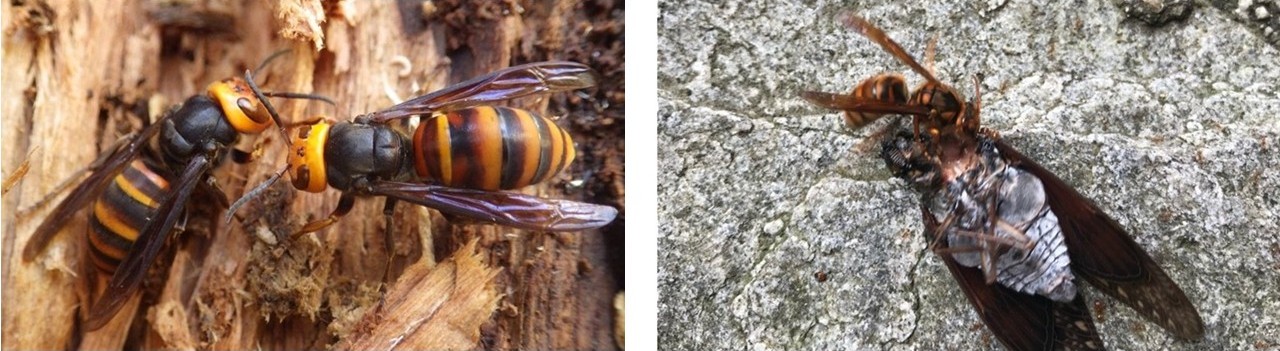
写真左) コガタスズメバチ写真右) アブラゼミを狩るキイロスズメバチ
<関連情報>
- https://www.kobe-u.ac.jp/ja/news/article/20251104-67107/
- https://www.schweizerbart.de/papers/entomologia/detail/prepub/107373/Urbanization_reduces_prey_diversity_and_promotes_d?af=crossref
都市化は獲物の多様性を減少させ、同所性スズメバチ種の食性の分岐を促進する Urbanization reduces prey diversity and promotes dietary divergence in sympatric hornet species
Saga, Tatsuya; Taichi, Nakata
Entomologia Generalis Published:Nov 4, 2025
DOI:https://doi.org/10.1127/entomologia/3749
Abstract
Urbanization is a major driver of ecological change, but its effects on predator foraging behavior and trophic structure remain underexplored. We investigated how fine-scale urbanization affects prey diversity and composition in two sympatric hornet species, Vespa analis Fabricius (Hymenoptera: Vespidae) and V. simillima Smith, in central Japan. Using DNA metabarcoding of larval gut contents and high-resolution land cover data, we quantified prey richness and community turnover across urban and nonurban colonies. We found that prey species richness declined significantly with increasing developed land area, particularly within a 500 m radius of the nest. This pattern was observed in both species, suggesting that local habitat structure strongly constrains dietary opportunities. Despite similar declines in prey species richness, the two species presented distinct trophic responses: V. analis presented greater dietary turnover between urban and nonurban sites, whereas V. simillima showed moderately smaller compositional shifts. Prey order composition revealed species-specific preferences. V. analis consumed more Coleoptera and Hymenoptera in urban areas, whereas V. simillima selectively foraged on Lepidoptera in nonurban environments. Indicator species analysis and nonmetric multidimensional scaling confirmed stronger compositional shifts in V. analis, indicating greater trophic plasticity. Notably, V. simillima DNA was frequently detected in V. analis gut, raising the possibility of intraguild interactions under urban pressure. Our results highlight how fine-scale urbanization drives trophic divergence in sympatric predators, shaped by prey accessibility, quality, and behavioral flexibility. These findings contribute to the development of trait-based frameworks of urban ecological filtering and predator coexistence, and they have broader implications for understanding trophic responses to landscape modification across diverse ecosystems and predator guilds.