
2025-10-31 シカゴ大学(UChicago)
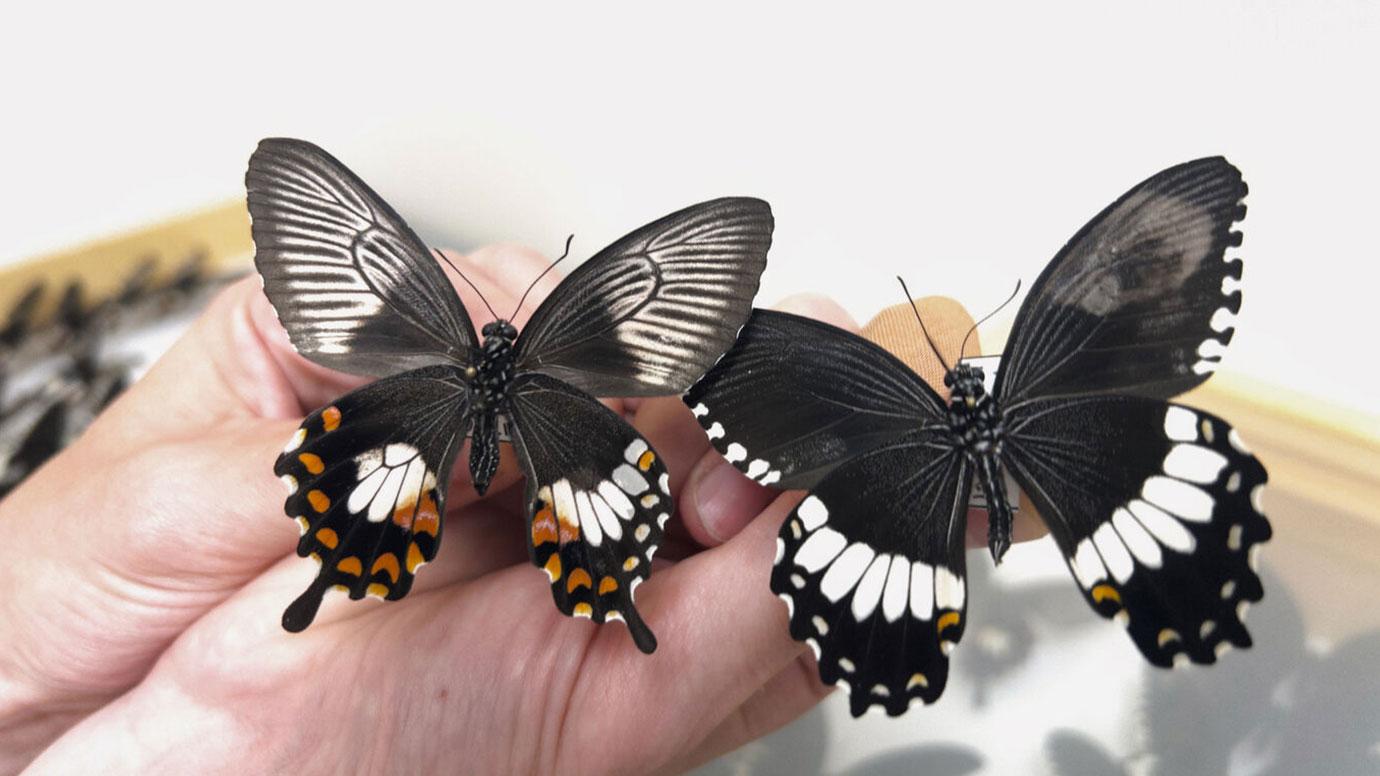
The female swallowtail butterfly (left) has extra orange spots and a different shape on its wings to mimic species that are toxic to predators, while the male (right) has the standard set of white patches on a black background.Photo courtesy of Grant Czadzek
<関連情報>
- https://news.uchicago.edu/story/secrets-butterfly-supergene-controls-wing-colors-and-patterns
- https://www.pnas.org/doi/10.1073/pnas.2509864122
蝶の擬態スーパー遺伝子の機能的遺伝要素 Functional genetic elements of a butterfly mimicry supergene
Nicholas W. VanKuren, Sofia I. Sheikh, Claire L. Fu, +3 , and Marcus R. Kronforst
Proceedings of the National Academy of Sciences Published:October 8, 2025
DOI:https://doi.org/10.1073/pnas.2509864122
Significance
Balanced polymorphisms are often controlled by genetic variation in just a single locus that switches between alternate phenotypes. Here, we establish that novel cis-regulatory elements (CREs) of the conserved transcription factor gene doublesex underlie the switch between mimetic and nonmimetic butterfly wing patterns. dsx and these novel CREs are locked together by an inversion, showing that this dsx “supergene” combines traditional concepts of multigene supergenes with our current understanding of the complexity of gene regulation. We identify a molecular basis for the functions of a historically important supergene and provide insight into how conserved genes can be co-opted into new roles in development.
Abstract
Development requires the coordinated action of many genes across space and time, yet numerous species can develop discrete, alternate phenotypes. Such complex balanced polymorphisms are often controlled by supergenes: multiple tightly linked loci that function together to control development of a complex phenotype. Supergenes are widespread in nature. However, the evolution and functions of supergene alleles remain obscure because the identities of the functional loci, and the causative variation between them, remain essentially unknown. The doublesex supergene controls mimicry polymorphism in the swallowtail butterflies Papilio polytes and Papilio alphenor. Alternate alleles cause development of discrete mimetic or nonmimetic wing patterns. We found that the mimetic allele evolved by gaining six new cis-regulatory elements (CREs) and an inversion that locked those CREs together with dsx and the novel noncoding gene U3X. At least four of these new CREs are essential for dsx expression and mimetic pattern development. Genome-wide assays of DSX binding suggest that dsx controls mimetic pattern development by directly regulating the expression of both itself and a handful of unlinked genes. The dsx supergene thus contains multiple functional genetic elements, each required for the phenotype switch and linked together by an inversion, and likely exerts its effects on color pattern development through direct regulation of unlinked “modifier” genes. Our results therefore support classic theories of supergene evolution, but update those ideas to match what we have learned about gene regulation since their development over a half century ago.

