2025-11-13 オックスフォード大学
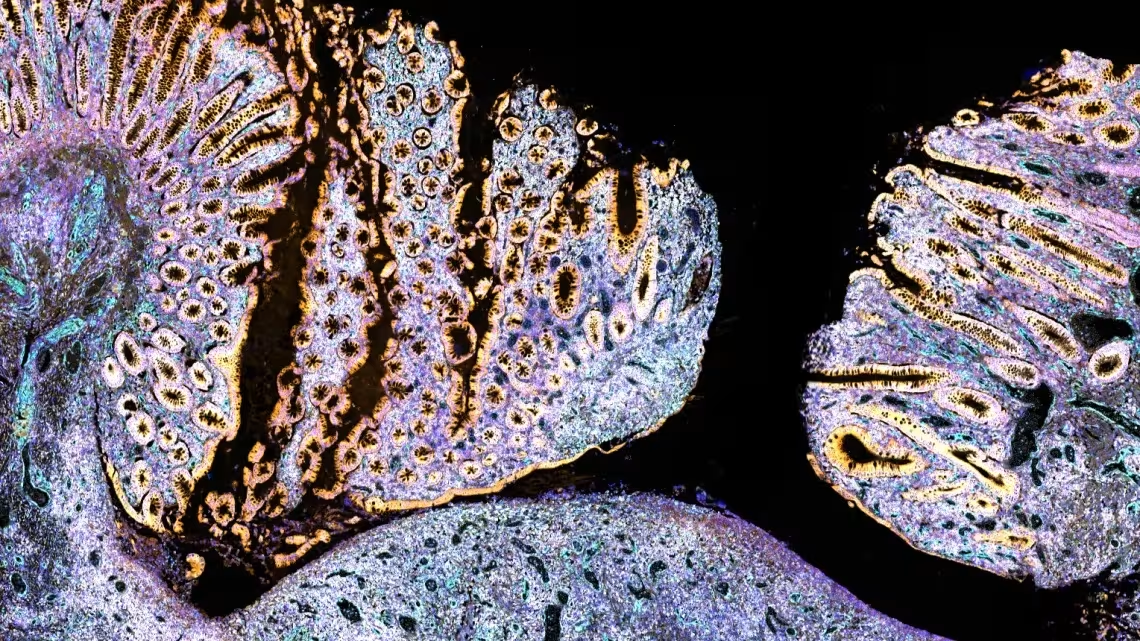
Spatial transcriptomics image showing a partially epithelialised fistula tract – this means parts of the tunnel have grown a new lining, while others have not. This is part of the disordered healing process that occurs in Crohn’s fistulas. Each colour in the image represents a different type of cell.
<関連情報>
- https://www.ox.ac.uk/news/2025-11-13-oxford-scientists-map-cells-drive-crohn-s-disease-fistulas-paving-way-targeted
- https://www.nature.com/articles/s41586-025-09744-y
空間的な線維芽細胞ニッチがクローン病瘻を定義する Spatial fibroblast niches define Crohn’s fistulae
Colleen McGregor,Xiao Qin,Marta Jagielowicz,Tarun Gupta,Zinan Yin,Verena Lentsch,David Fawkner-Corbett,Vy Wien Lai,Paula Gomez Castro,Esther Bridges,Chloe Hyun-Jung Lee,Huei-Wen Chuang,Lei Deng,Anna Aulicino,Renuka Teague,Sorayya Moradi,Jun Sung Park,Jeongmin Woo,Kexin Xu,Ruchi Tandon,Nicole Cianci,Jan Bornschein,Ling-Pei Ho,Paulina Siejka-Zielinska,… Alison Simmons
Nature Published:12 November 2025
DOI:https://doi.org/10.1038/s41586-025-09744-y
Abstract
Crohn’s disease often presents with fistulae, abnormal tunnels that connect the intestine to the skin or other organs. Despite their profound effect on morbidity, the molecular basis of fistula formation remains unclear, largely owing to the challenge of capturing intact fistula tracts and their inherent heterogeneity1,2,3. Here we construct a subcellular-resolution spatial atlas of 68 intestinal fistulae spanning diverse anatomical locations. We describe fistula-associated epithelial, immune and stromal cell states, revealing abnormal zonation of growth factors and morphogens linked to establishment of tunnelling anatomy. We identify fistula-associated stromal (FAS) fibroblasts, which are assembled in concentric layers: a proliferative, lumen-adjacent zone beneath neutrophil and macrophage-rich granulation tissue, an active lesion core of FAS cells and a quiescent, pro-fibrotic outer zone. We examine the architecture of the extracellular matrix in the fistula tract and demonstrate that FAS populations associate with distinct collagen structures, exhibiting properties ranging from proliferation, migration and extracellular matrix remodelling to dense collagen deposition and fibrosis. We define niches supporting epithelialization of fistula tunnels and a FAS-like population that is detected at the base of ulcers in non-penetrating Crohn’s disease. Our study demonstrates that common molecular pathways and cellular niches underpin fistulae across intestinal locations, revealing the cellular protagonists of fistula establishment and persistence. This resource will inform the development of model systems and interventions to mitigate aberrant fibroblast activity while preserving their regenerative properties in Crohn’s disease.