2025-11-13 中国科学院(CAS)
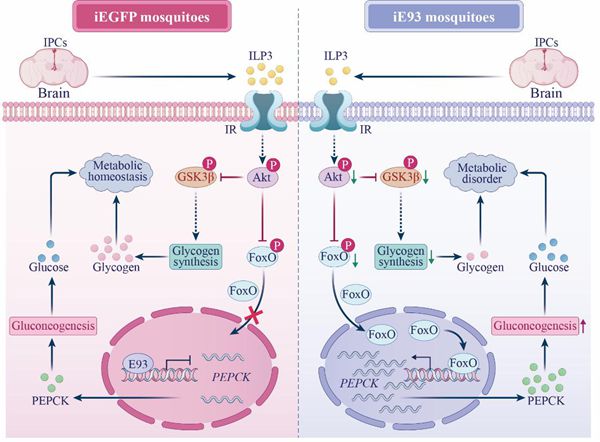
The diagram illustrates the mechanism of E93-mediated metabolic homeostasis in the A. aegypti female mosquitoes following a blood meal. (Image by Prof. ZOU Zhen’s Lab)
<関連情報>
- https://english.cas.cn/newsroom/research_news/life/202511/t20251113_1115118.shtml
- https://www.pnas.org/doi/10.1073/pnas.2511572122
蚊のエクジソン誘導遺伝子E93によるゲノムおよびインスリンを介した代謝恒常性制御 Genomic and insulin-mediated control of metabolic homeostasis by the mosquito ecdysone-induced gene E93
Xueli Wang, Danqian Geng, Kai Shi, +4 , and Zhen Zou
Proceedings of the National Academy of Sciences Published:October 29, 2025
DOI:https://doi.org/10.1073/pnas.2511572122
Significance
Female mosquitoes are major disease vectors because they require blood feeding for reproduction. Metabolic events are synchronized with the reproductive cycles to meet their energy demands. Ecdysone-induced protein 93 (E93), a key factor governing insect metamorphosis and reproductive cyclicity, orchestrates metabolic homeostasis through a dual mechanism in mosquitoes. E93 knockdown negatively affected insulin-like peptide 3 (ILP3) production, thereby inhibiting the activation of insulin signaling cascade. This resulted in reduced phosphorylation of protein kinase B (Akt) and glycogen synthase kinase 3β (GSK3β), and promoted FoxO nuclear translocation. Furthermore, E93 directly inhibited PEPCK expression. Accordingly, E93 knockdown led to lower glycogen content and higher glucose levels. Our work provides insight into the metabolic regulation of disease-transmitting mosquitoes.
Abstract
Ecdysone-induced protein 93 (E93) is an adult specifier that governs insect pupal-adult conversion. It affects the reproductive transition in adult Aedes aegypti mosquitoes, the significant vectors of numerous devastating human diseases. Here, we show that E93 is essential for maintaining metabolic homeostasis during the reproductive cycle of mosquitoes. E93 deficiency led to insufficient production of insulin-like peptide 3 (ILP3) from insulin-producing cells in the brain, resulting in reduced phosphorylation of protein kinase B (Akt), a key regulator in the insulin signaling pathway. This reduction facilitated the nuclear translocation of FoxO and enhanced the activity of glycogen synthase kinase 3β (GSK3β), which in turn respectively activated the transcription of genes encoding phosphoenolpyruvate carboxykinase (PEPCK) during gluconeogenesis and reduced glycogen synthesis. Further insulin rescue and the luciferase activity assays demonstrated that E93 directly inhibited PEPCK transcription. Ultimately, E93-depleted mosquitoes exhibited systemic metabolic reprogramming, characterized by the dysregulation of carbohydrate, lipid, and amino acid metabolism. Our findings establish that E93 orchestrates metabolic homeostasis by coordinating the insulin signaling cascade and directly regulating PEPCK expression, thus providing an intrinsic connection between endocrine signaling and E93-mediated reproduction in mosquitoes.