2025-11-20 ロックフェラー大学
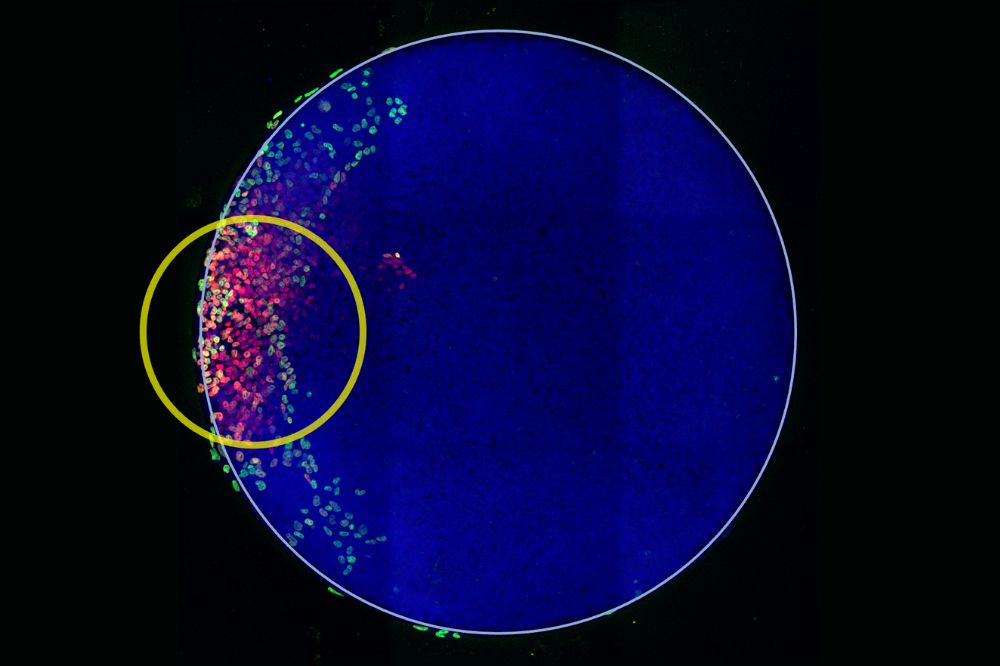
Scientists in the Brivanlou lab used light-inducible gene expression (yellow circle) and embryo models to demonstrate that, at the start of gastrulation, body-axis formation requires an interplay between biochemical signals and mechanical forces. (Credit: Brivanlou lab)
<関連情報>
- https://www.rockefeller.edu/news/38639-mechanical-forces-are-key-to-embryonic-self-organization/
- https://www.cell.com/cell-stem-cell/abstract/S1934-5909(25)00337-6
組織力学とBMP4シグナル伝達のクロストークがヒト胚モデルにおける対称性の破壊を制御する Crosstalk between tissue mechanics and BMP4 signaling regulates symmetry breaking in human gastrula models
Riccardo De Santis ∙ Laurent Jutras-Dubé ∙ Sophia Bourdrel ∙ Eleni Rice ∙ Francesco M. Piccolo ∙ Ali H. Brivanlou
Cell Stem Cell Published:October 13, 2025
DOI:https://doi.org/10.1016/j.stem.2025.09.006
Highlights
- Optogenetic induction of BMP4 enables spatiotemporal control of signaling in hESCs
- BMP4-induced epiblast symmetry breaking depends on mechanical signals via YAP1
- Mathematical modeling captures the impact of mechanical signals on morphogen dynamics
Summary
The spatiotemporal regulation of morphogenetic signals, along with local tissue mechanics, guides morphogenesis and determines the shape of the embryo. However, how these signals integrate into developmental circuits remains poorly understood. Here, we developed a light-inducible strategy to induce BMP4 signaling with precise spatial coordinates in human pluripotent stem cells. Light-controlled BMP4 induces SMAD1–5 phosphorylation, resulting in amnion differentiation, and relies on a tension-dependent induction of WNT and NODAL for mesoderm differentiation. In response to BMP4 signaling, the mechanosensitive transcription factor YAP1 accumulates in the nucleus, where it represses WNT3 mRNA, regulating the induction of the three germ layers. Based on these findings, we developed a mathematical model that integrates tissue mechanics into morphogen dynamics, quantitatively explaining tissue-scale responses to BMP4 signaling. Thus, light induction of the morphogen BMP4 in human stem cell models elucidated the interplay between tissue mechanics and signaling at the onset of gastrulation.