2025-12-02 スイス連邦工科大学ローザンヌ校(EPFL)
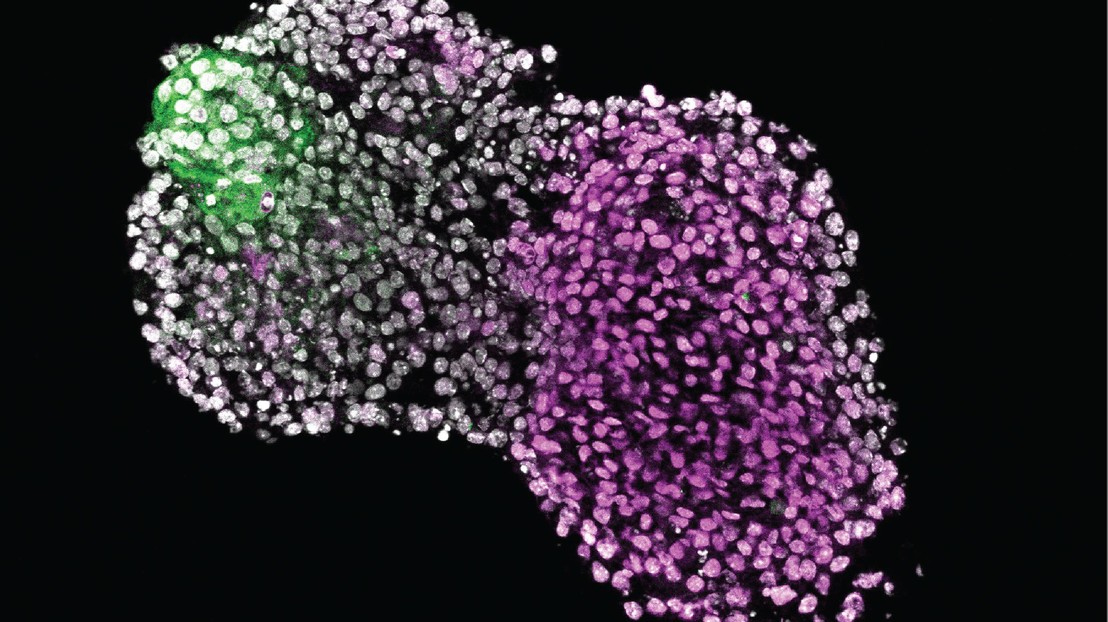
Fluorescence imaging of a budoid. Magenta: forming cartilage. Green: AER cells. Credit: 2025 EPFL/Evangelia Skoufa/Can Aztekin – CC-BY-SA 4.0
<関連情報>
- https://actu.epfl.ch/news/stem-cell-organoids-mimic-aspects-of-early-limb-de/
- https://www.science.org/doi/10.1126/sciadv.ady7682
中胚葉オルガノイドモデルにおいて、特殊なシグナル伝達センターが細胞運命と空間組織を指示する Specialized signaling centers direct cell fate and spatial organization in a mesodermal organoid model
Evangelia Skoufa, Jixing Zhong, Kelly Hu, Oliver Kahre, […] , and Can Aztekin
Science Advances Published:28 Nov 2025
DOI:https://doi.org/10.1126/sciadv.ady7682
Abstract
Specialized signaling centers orchestrate robust development and regeneration. Limb morphogenesis, for instance, requires interactions between the mesoderm and the signaling center apical-ectodermal ridge (AER), whose properties and role in cell fate decisions have remained challenging to dissect. To tackle this, we developed mouse embryonic stem cell (mESC)–based heterogeneous cultures and a three-dimensional (3D) organoid model, termed budoids, comprising cells with AER, surface ectoderm, and mesoderm properties. mESCs were first induced into heterogeneous cultures that self-organized into domes in 2D. Aggregating these cultures formed mesodermal organoids with certain limb bud–like features in 3D, exhibiting chondrogenesis-based symmetry breaking and elongation. Using our organoids and quantitative in situ expression profiling, we uncovered that AER-like cells support nearby limb mesoderm and fibroblast identities while enhancing tissue polarization that permits distant cartilage formation. Together, our findings provide a powerful model to study epithelial signaling center-mesoderm interactions during morphogenesis and reveal the ability of signaling center AER cells to concurrently modulate cell fate and spatial organization.