2025-12-09 京都大学
京都大学・熊本大学・千葉大学などの研究チームは、多年生植物オオバコの種子が、植食者であるダンゴムシの糞に含まれる化学物質を感知し、発芽を一時的に停止して食害を回避する仕組みを発見した。糞中に含まれる「トレハロース」と植物ホルモン「アブシジン酸(ABA)」が発芽を抑制し、これらの物質が雨で洗い流されると発芽が再開することが明らかになった。野外観察では、ダンゴムシの糞がある環境では雨天時に発芽が集中し、ダンゴムシの活動が低下して食害が生じにくいことが確認された。従来、種子の発芽制御は光・温度・水など物理環境への応答として理解されてきたが、本研究は動物の糞という生物由来刺激を利用して生存確率を高める新たな適応戦略を示した点で画期的である。植物と植食者の間の化学的コミュニケーションの存在を示す発見であり、生態進化学・植物保護学の新領域を切り開く成果である。研究成果は New Phytologist に掲載された。
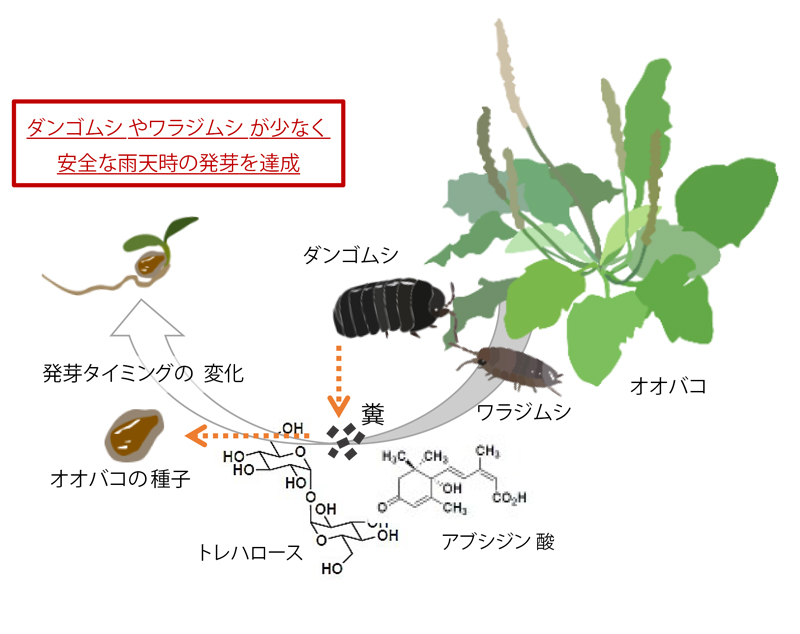
研究の概要図:ダンゴムシの糞に含まれる2つの化学物質がダンゴムシの活動が低下する安全な雨天時の種子の発芽を促進する。
<関連情報>
- https://www.kyoto-u.ac.jp/ja/research-news/2025-12-09-0
- https://www.kyoto-u.ac.jp/sites/default/files/2025-12/web_2512_Yamawo-513028b318bd6bb0d240635cd4260c24.pdf
- https://nph.onlinelibrary.wiley.com/doi/10.1111/nph.70750
等脚類の糞便による発芽時期の変化は実生の定着を促進する Isopod feces–mediated shifts in germination timing enhance seedling establishment
Akira Yamawo, Hayato Ishikawa, Masatsugu Takekawa, Nanako Nakashima, Haruna Ohsaki, Hiromi Mukai, Yuri Kanno, Mitsunori Seo, Yasushi Todoroki, Jun Takeuchi, Shinichiro Sawa
New Phytologist Published: 08 December 2025
DOI:https://doi.org/10.1111/nph.70750
Summary
- Seedlings are particularly vulnerable to herbivory because their defenses are underdeveloped and their capacity to tolerate damage is limited. However, how seedlings cope with such threats remains poorly understood. Animal feces may provide important chemical cues that influence plant responses to herbivory.
- We examined whether the presence of isopod feces affects the herbivory of Japanese plantain (Plantago asiatica) seedlings in the field. Laboratory experiments were also conducted to test the effects of herbivore feces on P. asiatica germination. Bioactive compounds in the feces that regulate seed germination were extracted and identified.
- The field experiments indicated that the presence of isopod feces induces seed germination on rainy days (when isopod activity is low), reduces herbivory, and triples the survival rate of P. asiatica seedlings. In the laboratory, feces from isopods that had recently fed on P. asiatica leaves suppressed seed germination. However, germination resumed after simulated rain washed them away. Chemical analyses revealed that trehalose and abscisic acid are the active compounds responsible for germination suppression.
- These findings demonstrate that the detection of chemical cues in animal feces by seeds alters their germination timing accordingly, thereby increasing their chances of survival in environments with high herbivore densities.