
2025-12-19 ゲーテ大学
<関連情報>
- https://aktuelles.uni-frankfurt.de/english/continuous-spread-raccoon-roundworm-detected-in-nine-european-countries/
- https://link.springer.com/article/10.1007/s00436-025-08611-z
ヨーロッパで増加しているベイリサスカリス・プロキオニス:発生データの包括的なレビューと分析 Baylisascaris procyonis on the rise in Europe: a comprehensive review and analysis of occurrence data
Anne Steinhoff,Robin Stutz,Anna Viktoria Schantz,Norbert Peter,Dorian D. Dörge & Sven Klimpel
Parasitology Research Published:09 December 2025
DOI:https://doi.org/10.1007/s00436-025-08611-z
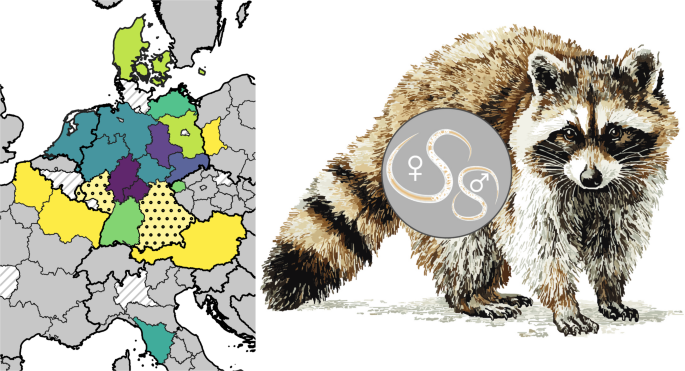
Graphical Abstract
Abstract
The raccoon roundworm (Baylisascaris procyonis) was introduced to Europe by its final host, the North American raccoon (Procyon lotor), which has been spreading uncontrollably there since the early 20th century. The raccoon is gaining importance due to the spread of the raccoon roundworm, which is pathogenic to humans and can cause severe disease through oral ingestion of infectious egg stages. Totally, 146 raccoons from central and western Germany were examined for B. procyonis via necropsy. In addition, an extensive literature search was conducted on the occurrence of B. procyonis in Europe. Of the 146 raccoons examined in this study, 66.4% were infected with B. procyonis: 77.4% in Hesse (n = 84), 51.1% in Thuringia (n = 45), and 52.9% in North Rhine-Westphalia (n = 17). The literature review revealed the presence of B. procyonis in wild raccoons in nine European countries. In three additional countries, infections were detected in raccoons or other animal species in captivity. The studies show a steady expansion of the distribution area, which is probably underestimated due to insufficient or absent data collection. Five animal species have been identified as paratenic/accidental hosts in Europe, with all infections documented in zoos/animal husbandry. There is a lack of data on paratenic hosts in the wild in Europe. There are three documented cases of Baylisascariasis in Europe. The results of the present study highlight the need for further research into B. procyonis in Europe, particularly in relation to ongoing urbanization and growing raccoon populations.

