2025-12-19 京都大学
<関連情報>
- https://www.kyoto-u.ac.jp/ja/research-news/2025-12-19-0
- https://www.kyoto-u.ac.jp/sites/default/files/2025-12/web_2512_Taketo-8cf9cc361a341955787b64397468e201.pdf
- https://onlinelibrary.wiley.com/doi/10.1111/cas.70235
患者の予後を予測できる包括的な大腸がん幹細胞トランスクリプトームシグネチャー Comprehensive Colorectal Cancer Stem Cell Transcriptomic Signatures That Can Predict Patient Prognostic Outcomes
Fumihiko Kakizaki, Hiroyuki Miyoshi, Takehito Yamamoto, Tomonori Morimoto, Hiroyuki Matsubara, Shoichi Kitano, Tadayoshi Yamaura, Hisatsugu Maekawa, J. B. Brown, Tosiya Shun Sato …
Cancer Science Published: 31 October 2025
DOI:https://doi.org/10.1111/cas.70235
ABSTRACT
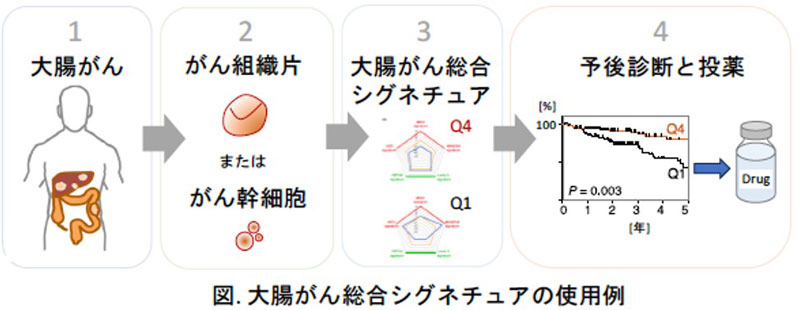
Based on mRNA Expression Profiles of 57 Patient-Derived Colorectal Cancer Stem-Like Cell (CRC-SC) Lines Compared With Normal Colonic Epithelial Stem-Like Cells (NCE-SCs), we Identified Five CRC Subtypes. The First Subtype of CRC-SCs Showed Markedly Increased Expression of MUC12, PIGR, PLA2G2A, SLC4A4, and ZG16, Which Were Barely Detectable in the Other Subtypes. Importantly, Their Expression Correlated With Favorable Outcomes in Both the Discovery Cohort and Independent Two Test Cohorts From Public Databases. The Remaining Four Subtypes Showed High Expression of DEFA6, BST2, MAGEA6, or IGF2 Compared With NCE-SCs. Although the Expression of Each Gene Individually Influenced Patient Outcomes, Additional Co-Expressed Genes Within Each Subtype Were Also Associated With Prognosis. Furthermore, Integrating the Five Subtype-Specific Signatures Produced a Practical Prognostic Indicator, Designated as the General Colorectal Cancer Signature (GCS), and Provided Individualized Predictive Signatures for Each Patient. The Clinical Significance of GCS Was Further Validated in a Novel Orthotopic Xenograft Mouse Model, Which Recapitulated Patient Outcomes: CRC-SCs With Low GCS Scores Developed Distinct Liver and Lung Metastases, Whereas Those With High Scores Did Not. Apparent Associations Were Observed Between Activating RAS/RAF Mutations and BST2 Expression, and Between the Absence of SMAD4 Mutation and IGF2 Expression, but These Had no Significant Impact on Patient Survival, Suggesting That Driver Gene Mutations May Not Directly Influence GCS. Collectively, Our Findings Provide a Comprehensive Overview of Clinically Relevant Molecular Subtypes of CRC-SCs, Representing the Current Landscape of CRC Molecular Expression Subtypes. They Also Enable Rapid, Low-Cost Outcome Prediction and Suggest Potential Targets for Therapeutics Development.