2026-01-07 中国科学院(CAS)
<関連情報>
- https://english.cas.cn/newsroom/research-news/202602/t20260210_1150320.shtml
- https://pubs.acs.org/doi/10.1021/acsnano.5c15989
ウキクサにおけるナノプラスチック:単一細胞反応と回復 Nanoplastics in Duckweed: Single-Cell Responses and Recovery
Wenke Yuan,Elvis Genbo Xu,Dong Zhu,Weihong Zhang,Wenzhi Liu,Fazel Abdolahpur Monikh,Li Lin,Lianzhen Li,Hans-Peter Grossart,Yuyi Yang,Matthias C. Rillig,and Willie J. G. M. Peijnenburg
ACS Nano Published: December 16, 2025
DOI:https://doi.org/10.1021/acsnano.5c15989
Abstract
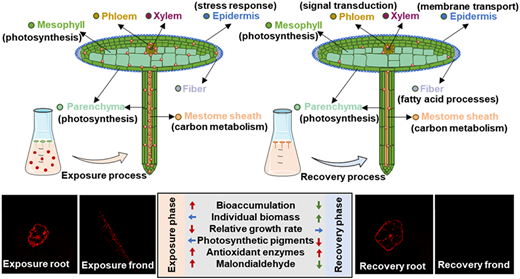
Micro- and nanoplastics have emerged as critical contaminants in aquatic ecosystems due to their small size, persistent nature, and potential for bioaccumulation. Nanoplastics are particularly concerning because they can be widespread in aquatic environments and ingested by aquatic organisms, posing potential risks to ecological health and environmental sustainability. However, the response and recovery of aquatic plants to nanoplastics, as well as the cell-specific molecular mechanisms underlying these processes, remain unclear. By integrating single-cell transcriptomics, enzymatic assays, and europium-doped nanoplastic tracing, we comprehensively investigated the response of duckweed to polystyrene nanoplastics at environmentally relevant and high doses over exposure and recovery phases. Nanoplastics exposure reduced plant reproduction and root length by inducing oxidative damage, with partial recovery after removal. Single-nucleus RNA sequencing revealed cell-type-specific responses of duckweed to nanoplastics, particularly in mesophyll, mestome sheath, epidermis, and parenchyma cells. Interestingly, recovery triggered a greater number of differentially expressed genes mechanistically linked to carbon metabolism, membrane transport, and stress-responsive pathways. Nanotracer quantification demonstrated root/frond absorption and 36.8–51.4% postrecovery excretion. These multiscale lines of evidence decipher the molecular strategies of duckweed to nanoplastics at single-cell resolution, providing mechanistic insights into the interactions between aquatic plants and nanoplastics contamination.