2026-01-14 神戸大学
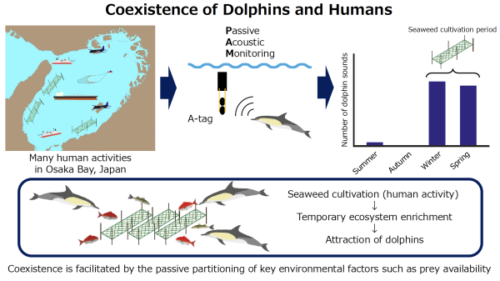
本研究は、日本の大阪湾を対象に、イルカ類と海洋経済活動(漁業、船舶交通、沿岸利用など)がどのように共存し得るかを実証的に示したものです。研究者らは受動音響モニタリングなどのデータを用い、イルカの出現・行動パターンと人間活動の時空間的関係を解析しました。その結果、イルカ群は特定季節や時間帯に頻繁に現れる場所があり、同時に経済活動が活発な海域でも観察され、完全な排他関係にはないことが示されました。こうした現地データに基づく解析は、野生イルカの保全と地域経済活動の両立に向けた科学的根拠を提供し、管理・政策立案への応用が期待されます。
論文は国際誌『Aquatic Mammals』52巻1号に掲載されたオープンアクセス論文です。
<関連情報>
- https://www.kobe-u.ac.jp/ja/news/article/20260114-67450/
- https://www.aquaticmammalsjournal.org/article/a-possible-example-of-the-coexistence-of-dolphins-and-marine-economic-activity-in-osaka-bay-japan/
- https://www.aquaticmammalsjournal.org/wp-content/uploads/2026/01/52.1_Iwata.pdf
大阪湾におけるイルカと海洋経済活動の共存の可能性
A Possible Example of the Coexistence of Dolphins and Marine Economic Activity in Osaka Bay, Japan
Takashi Iwata, Taichi Matsumoto, Mayu I. Ogawa, Tomonari Akamatsu, Takahide Araki, and Satoko S. Kimura
Aquatic Mammals Published:1 January 2026
DOI:https://doi.org/10.1578/AM.52.1.2026.1
Conflicts between marine predators and marine eco-nomic activities have been reported globally (Weir & Pierce, 2013; Nyhus, 2016), with particularly notable predation impacts on fisheries (Jog et al.,2022). These marine predators may engage in pick-up feeding by consuming discarded fish from fishing vessels (Papale et al., 2020; Iwata et al., 2024) or in depredation by removing fish directly from fishing gear (Tixier et al., 2021). Moreover, their presence can reduce fishing efficiency by dispersing target species in fishing grounds. Consequently,fishers may perceive marine top predators as competitors for valuable resources.
Conversely, marine predators themselves are negatively affected by fisheries. For instance,they face threats such as entanglement in fishing gear and bycatch (Soykan et al., 2008), which represent significant anthropogenic impacts.
Furthermore, resource competition often arises because both fishers and marine predators rely on similar target species (DeMaster et al., 2001).However, the relationship between fisheries and marine predators is not always antagonis-tic.
In certain cases, their coexistence may pro-vide mutual benefits. For example, Romero-Tenorio et al.(2022) reported that the presence of small odontocetes in offshore waters—over 50km from the coast—can serve as an indica-tor of the availability of commercially targeted fish species, despite potential conflict in coastal areas. Additionally, cooperative capturing of fish between fishers and odontocetes has been documented in some regions (Cantor et al., 2023). These findings suggest that interactions between marine predators and fisheries can range from competitive to cooperative, depend ing on ecological and regional contexts.
Osaka Bay, located in the eastern part of the Seto Inland Sea, Japan, is a heavily urbanised coastal region characterised by extensive human activities, including aquaculture, commercial and recreational fisheries, intensive vessel traffic, and coastal infrastructure development. Adjacent to the metropolitan areas of Osaka and Kobe, together home to more than 19 million people
(United Nations [UN] Department of Economic and Social Affairs, 2019), the bay encompasses two of Japan’s five largest commercial ports. Consequently, the marine environment of Osaka Bay is subject to considerable anthropogenic Bay is subject to considerable anthropogenic pressure. In this bay, sightings of common dolphins (Delphinus delphis) and Indo-Pacific bottlenose dolphins (Tursiops aduncus) are frequently reported by local media, and previous studies have confirmed the distribution of the
narrow-ridged finless porpoise (Neophocaena asiaeorientalis) in the area (Kasuya et al., 2002; Hashimoto et al., 2024).
This study aims to investigate the interactions between small odontocetes and economic activities in a highly urbanised coastal area. To this end, passive acoustic monitoring (PAM) surveys were conducted in the Akashi Strait, located in the northwestern part of Osaka Bay.