2026-01-22電気通信大学
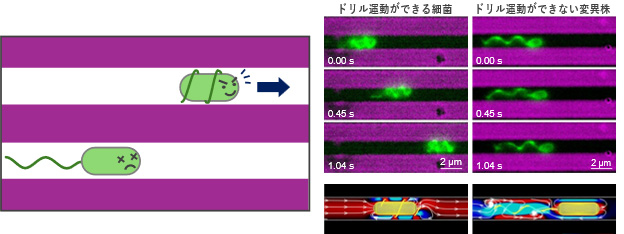
図:細菌がドリル運動で狭小空間を突破するイラスト(左)。極狭通路を通過する共生細菌。ドリル運動と通常の運動の比較(右上)。物理シミュレーションの結果(右下)。本リリース論文 Yoshioka, et al. Nat Commun (2026) を参照。
<関連情報>
- https://www.uec.ac.jp/news/newsrelease/2026/20260122_7393.html
- https://www.uec.ac.jp/about/publicity/news_release/2026/pdf/20260122_7393.pdf
- https://www.nature.com/articles/s41467-025-67507-9
細菌は鞭毛の巻きつきによって1マイクロメートル四方の通路を突破する Bacteria break through one-micrometer-square passages by flagellar wrapping
Aoba Yoshioka,Yoshiki Y. Shimada,Toshihiro Omori,Naoki A. Uemura,Kazutaka Takeshita,Kota Ishigami,Hiroyuki Morimura,Maiko Furubayashi,Tetsuo Kan,Hirofumi Wada,Yoshitomo Kikuchi &Daisuke Nakane
Nature Communications Published:20 January 2026
DOI:https://doi.org/10.1038/s41467-025-67507-9
Abstract
Confined spaces are omnipresent in the micro-environments, including soil aggregates and intestinal crypts, yet little is known about how bacteria behave under such conditions where movement is challenging due to spatial confinement that limited effective diffusion. Stinkbug symbiont Caballeronia insecticola navigates a narrow gut passage about one micrometer in diameter to reach the stinkbug’s symbiotic organ. Here, we developed a microfluidic device mimicking the host’s sorting organ, wherein bacterial cells are confined in a quasi-one-dimensional fashion, and revealed that this bacterium wraps flagellar filaments around its cell body like a screw thread to control fluid flow and generate propulsion for smooth and directional movement in narrow passages. Physical simulations and genetic experiments revealed that hook flexibility is essential for this wrapping; increasing hook rigidity impaired both wrapping motility and infectivity. Thus, flagellar wrapping likely represents an evolutionary innovation, enabling bacteria to break through confined environments using their motility machinery.