2026-02-09 京都大学
<関連情報>
- https://www.kyoto-u.ac.jp/ja/research-news/2026-02-09
- https://www.kyoto-u.ac.jp/sites/default/files/2026-02/web_2602_Nagai-a5b32ac2cce7f28b782863261352e7cd.pdf
- https://www.isct-cytotherapy.org/article/S1465-3249(26)00012-5/fulltext
細胞・遺伝子治療研究の進歩:35年間の計量書誌学的視点 Advancement in Cell and Gene Therapy Research: a 35-Year Bibliometric Perspective
Yuki Kitahara ∙ Hiroaki Koda ∙ Junya Kataoka ∙ … ∙ Ryo Nishino ∙ Tohru Yoshioka-Kobayashi ∙ Sumimasa Nagai
Cytotherapy Published:January 10, 2026
DOI:https://doi.org/10.1016/j.jcyt.2026.102056
Highlights
- A comprehensive bibliometric analysis of CGT research over 35 years was conducted.
- Transition to clinical research is slower in MSC and in vivo GT than in ex vivo GT
- High-impact papers are associated with broader cross-border co-authorship.
- The US–EU collaboration was positively associated with high-impact outcomes.
Abstract
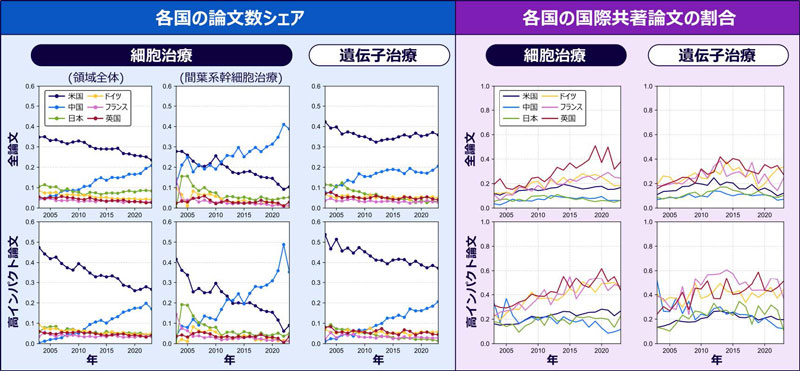
Cell and gene therapies (CGT) have been increasingly translated into clinical practice over the past three decades; however, their development has been uneven across modalities and regions. Through a bibliometric analysis indexed in PubMed from 1989 to 2023, supplemented by citation and affiliation data from OpenAlex, we examined modality-specific progression under different regional and collaborative configurations and how transitions from basic to clinical research have emerged. Hematopoietic stem cell therapies have shown sustained growth in both clinical and high-impact publications, reflecting a mature field that remains scientifically relevant. In contrast, mesenchymal stem cell therapies experienced a rise in high-impact papers in the mid-2000s, but clinical publications stagnated, indicating a gap between academic interest and clinical applications. In gene therapy, the number of in vivo approaches increased in the 1990s. However, this was followed by a plateau in high-impact publications and a decline in clinical output, whereas ex vivo strategies have sharply increased since the mid-2010s, marking a transition toward tangible clinical translation. To further evaluate the global research landscape, we analyzed research activity and co-authorship patterns across countries and institutions in CGT. Our findings reveal distinct patterns of international collaboration. The United States and, more recently, China accounted for a large and growing share of CGT publications and high-impact papers, whereas Europe maintained steady contributions, and Japan’s presence stagnated. Higher-impact output is generally associated with broader cross-border co-authorship, especially collaborations linking the United States and Europe, whereas collaborations involving China and Japan remain comparatively narrow. These results provide a data-driven foundation for guiding research policies and strategic cooperation in this evolving field.