2026-02-18 デラウェア大学
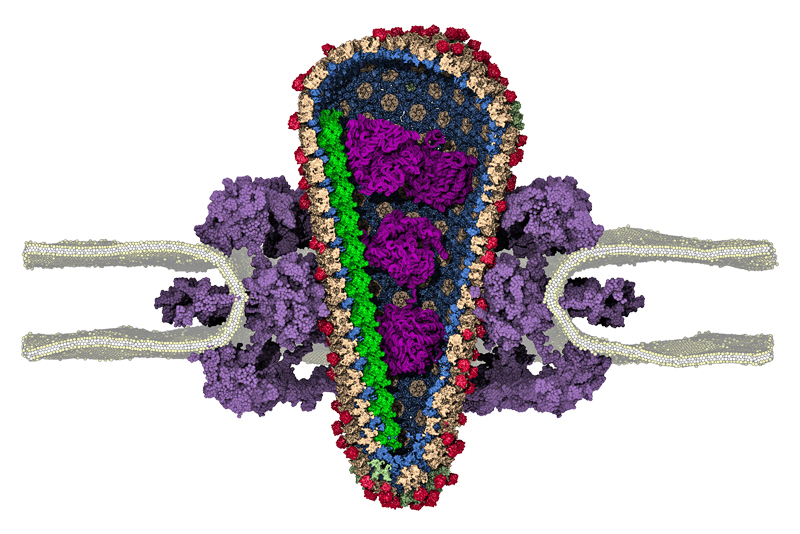
Side cutaway of the HIV-1 capsid entering a human cell’s nuclear pore complex, the gateway into the nucleus. Shown in green is the integrase filament that tiles along the hexamers of the capsid interior and helps to package the viral RNA (purple). Once inside the nucleus, the capsid breaks open and releases the virus’s genetic material and key enzymes. The protein integrase, which is one of these enzymes, helps insert the viral genome into the DNA of the host cell — an essential step in establishing HIV infection. Image by Juan S. Rey and Juan R. Perilla, University of Delaware.
<関連情報>
- https://www.udel.edu/udaily/2026/february/juan-perilla-juan-rey-hiv-virus-capsid-integrase-hidden-anchor/
- https://www.nature.com/articles/s41586-026-10154-x
インテグラーゼはウイルスRNAをHIV-1カプシド内部に固定する Integrase anchors viral RNA to the HIV-1 capsid interior
Matthew R. Singer,Zhen Li,Juan S. Rey,Joshua Hope,Florian Chenavier,Nicola J. Cook,Emma Punch,Jamie Smith,Zhiyu Zhou,Sarah Maslen,Laura Masino,Andrea Nans,Mark Skehel,Ian A. Taylor,Giulia Zanetti,Peijun Zhang,Juan R. Perilla,Alan N. Engelman & Peter Cherepanov
Nature Published:18 February 2026
DOI:https://doi.org/10.1038/s41586-026-10154-x
Abstract
HIV-1 integrase (IN) promotes encapsulation of viral genomic RNA into mature viral cores, and this function is a target for ongoing antiretroviral drug development efforts1,2,3. Here we determined the cryogenic electron microscopy (cryo-EM) structure of a primate lentiviral IN in a complex with RNA, revealing a linear filament made of IN octamer repeat units, each comprising a pair of asymmetric homotetramers. The assembly is stabilized through IN–RNA interactions involving mainly the IN C-terminal domains and RNA backbone. The spacing and orientation of the IN filament repeat units closely matched those of consecutive capsid (CA) hexamers within the mature CA lattice. Using cryo-EM images of native purified HIV-1 cores, we refined the structure of the IN filament as it propagates along the luminal side of the CA lattice. Each IN tetramer within the filament nestled in a CA hexamer, engaging closely with the major homology regions. Substitutions of residues involved in IN–CA contacts yielded eccentric virions with RNA nucleoids located outside of the cores. Collectively, our results establish the structural basis for the HIV-1 IN–RNA interaction and reveal that IN forms an RNA-binding module on the luminal side of the mature CA lattice.
アロステリックHIV-1インテグラーゼ阻害剤ピルミテグラビルに対するウイルス耐性の構造的およびメカニズム的基盤 The structural and mechanistic bases for the viral resistance to allosteric HIV-1 integrase inhibitor pirmitegravir
Tung Dinh, Zahira Tber, Juan S. Rey, Seema Mengshetti, Arun S. Annamalai, Reed Haney, Lorenzo Briganti,…, Mamuka Kvaratskhelia
mBio Published:15 October 2024
DOI:https://doi.org/10.1128/mbio.00465-24
ABSTRACT
Allosteric HIV-1 integrase (IN) inhibitors (ALLINIs) are investigational antiretroviral agents that potently impair virion maturation by inducing hyper-multimerization of IN and inhibiting its interaction with viral genomic RNA. The pyrrolopyridine-based ALLINI pirmitegravir (PIR) has recently advanced into phase 2a clinical trials. Previous cell culture-based viral breakthrough assays identified the HIV-1(Y99H/A128T IN) variant that confers substantial resistance to this inhibitor. Here, we have elucidated the unexpected mechanism of viral resistance to PIR. Although both Tyr99 and Ala128 are positioned within the inhibitor binding V-shaped cavity at the IN catalytic core domain (CCD) dimer interface, the Y99H/A128T IN mutations did not substantially affect the direct binding of PIR to the CCD dimer or functional oligomerization of full-length IN. Instead, the drug-resistant mutations introduced a steric hindrance at the inhibitor-mediated interface between CCD and C-terminal domain (CTD) and compromised CTD binding to the CCDY99H/A128T + PIR complex. Consequently, full-length INY99H/A128T was substantially less susceptible to the PIR-induced hyper-multimerization than the WT protein, and HIV-1(Y99H/A128T IN) conferred >150-fold resistance to the inhibitor compared with the WT virus. By rationally modifying PIR, we have developed its analog EKC110, which readily induced hyper-multimerization of INY99H/A128T in vitro and was ~14-fold more potent against HIV-1(Y99H/A128T IN) than the parent inhibitor. These findings suggest a path for developing improved PIR chemotypes with a higher barrier to resistance for their potential clinical use.