
2026-03-30 バッファロー大学(UB)
<関連情報>
- https://www.buffalo.edu/news/releases/2026/03/microplastics-aligners-study.html
- https://link.springer.com/article/10.1186/s40510-026-00608-3
矯正治療由来のマイクロプラスチックはマクロファージの分化と恒常性に影響を与える Orthodontic derived microplastics impact macrophage differentiation and homeostasis
Jordan Warunek,Stephen Warunek,Michael Calderon,Jonathan Franks,Simon Watkins,Heth Turnquist &Thikriat Al-Jewair
Progress in Orthodontics Published:06 February 2026
DOI:https://doi.org/10.1186/s40510-026-00608-3
Abstract
Background
Synthetic polymers are widely used in medical and dental appliances, including clear aligners, retainers, splints, and sleep devices. Despite their widespread use, little is known about the release of microplastics from traditional thermoformed polymers compared with recently developed direct-printed photopolymers. Plastic particles have been detected in a variety of human tissues such as, lung, liver, spleen and kidneys. Each of these sites contain local resident macrophages tasked with maintaining homeostasis by clearing cell debris and foreign bodies. Like these organs, the oral cavity has an extensive population of macrophages that complete immune surveillance and support oral tissue health. Therefore, orthodontic plastic particles may have profound local and systemic biological impacts. As such, we systematically characterized release and particle structure of several clinical orthodontic polymers and visualized their uptake and impacts on macrophage differentiation.
Methods
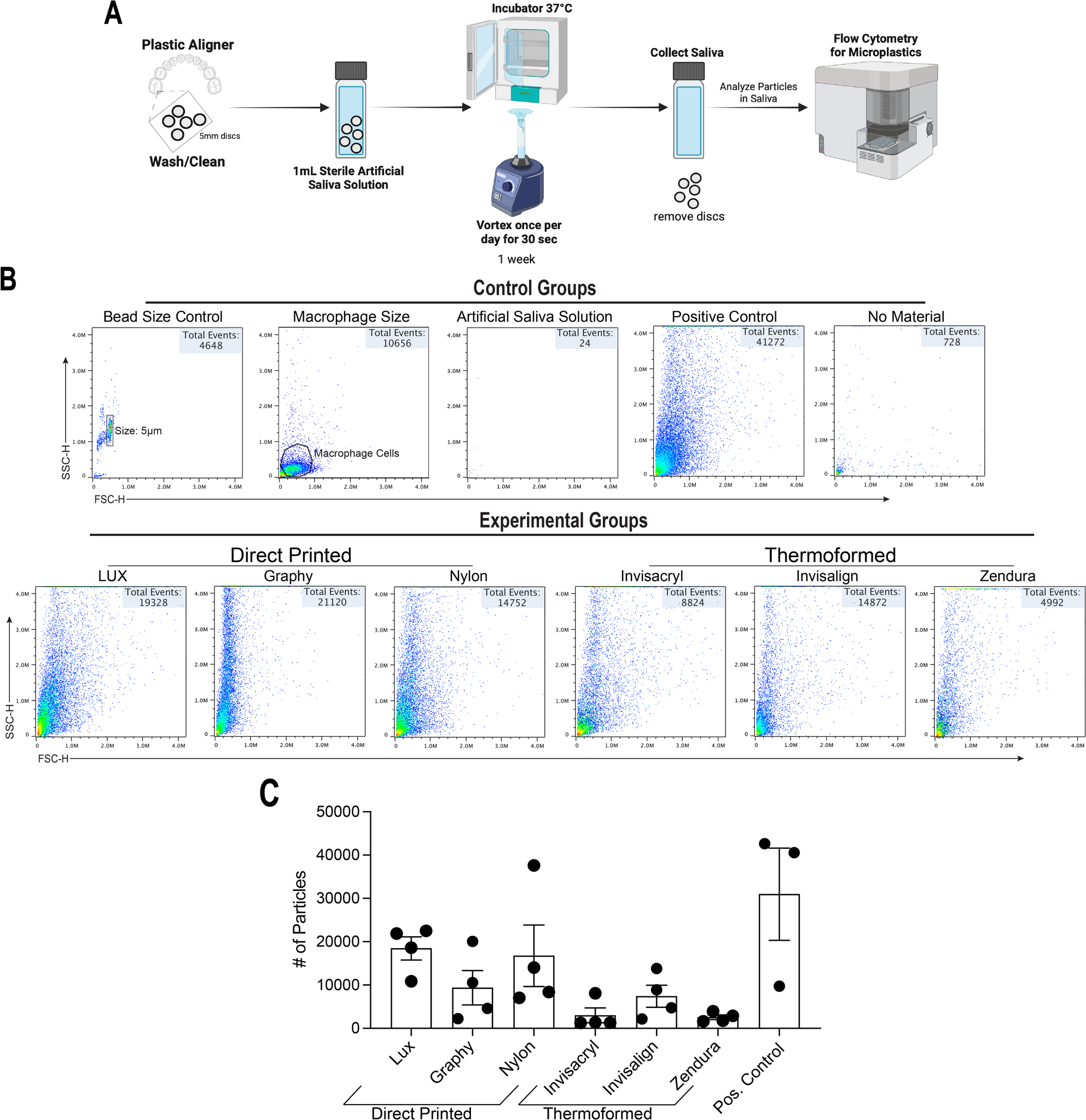
Polymers were tested with the following compositions, direct-printed resins: ActiveMemory™ DCA (Lux Creo Inc.), Tera Harz TA-28 (Graphy Inc.), Nylon 12 (EOS) and thermoformed materials: Invisacryl™ (Great Lakes Dental Technologies), Zendura® (Bay Materials), and Invisalign® (Align Technology Inc.). Equal-sized disks were submerged in artificial saliva, incubated, and vortexed daily for one week. Particle release was quantified by flow cytometry and imaged by scanning and transmission electron microscopy. Uptake by macrophages was captured using live-cell timelapse microscopy, and macrophage differentiation was assessed by flow cytometry three days following microplastic co-cultures.
Results
All materials released detectable particles, with direct-printed polymers producing the highest concentrations. Direct-printed materials shed more micro-sized plastics, whereas thermoformed materials predominantly released nano-sized particles. Macrophages readily phagocytosed plastics about 2–10 μm in size. Co-culture with urethane-based direct-printed materials promoted macrophage differentiation toward M1-like iNOS⁺CD86⁺ subsets associated with pro-inflammatory activity.
Conclusions
Our findings reveal that commonly used orthodontic materials release micro- and nano-plastics that are readily taken up by macrophages, with direct-printed polymers releasing higher levels of immunostimulatory particles. The resulting shift toward pro-inflammatory macrophage phenotypes raises concern that material choice could influence not only local oral health but also systemic immune responses. These results underscore the importance of evaluating microplastic release in dental and medical devices to guide safer material selection and minimize unintended biological consequences.

