
2026-04-10 スイス連邦工科大学ローザンヌ校(EPFL)
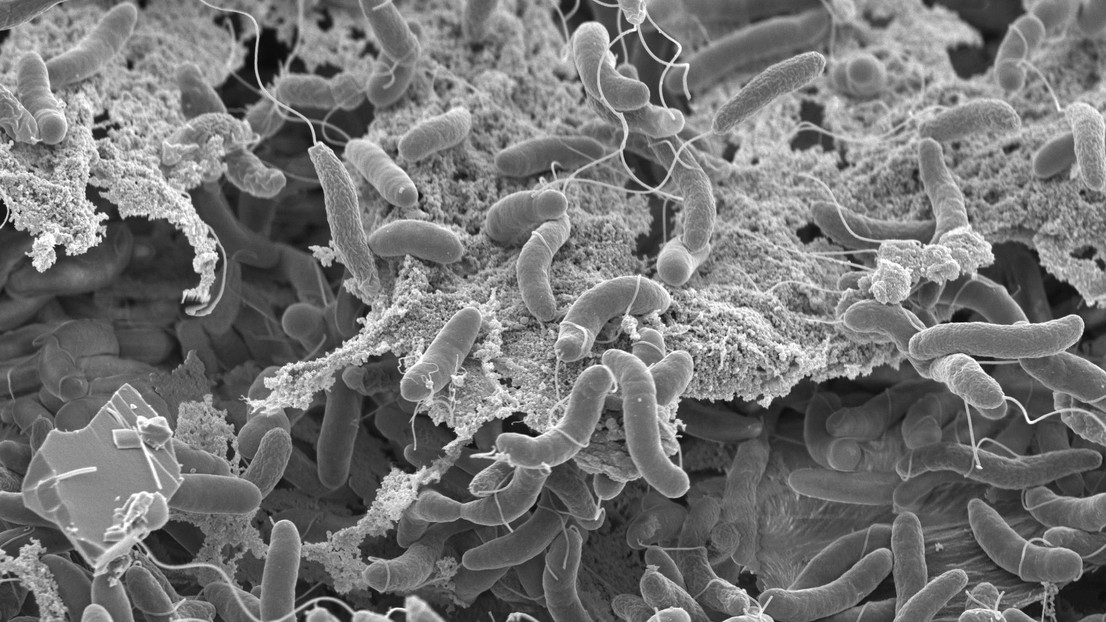
Vibrio cholerae on a chitinous surface. Photo taken with a Scanning Electron Microscope. Credit: Graham Knott and Melanie Blokesch © 2026 EPFL
<関連情報>
- https://actu.epfl.ch/news/how-cholera-bacteria-swap-defenses-against-viruses/
- https://www.science.org/doi/10.1126/science.aed0645
Competence-mediated DNA uptake diversifies Vibrio cholerae sedentary chromosomal integrons
Laurie Righi, Sandrine Stutzmann, Loriane Bader, Alexandre Lemopoulos, and Melanie Blokesch
Science Published:9 Apr 2026
DOI:https://doi.org/10.1126/science.aed0645
Editor’s summary
Vibrio cholerae bacteria contain a huge genetic element composed of multiple gene cassettes called a sedentary chromosomal integron (SCI). About 10% of the gene cassettes are important for phage defense. It was supposed that, under stress, the cassettes are shuffled to generate diversity, but this has not been observed for more than 60 years in human-associated pandemic cholera bacteria. Instead, Righi et al. show that the SCI diversifies in natural aquatic environments by the horizontal acquisition of genes released from dying bacteria growing on chitinous debris found in such environments. In human-associated environments, chitin is largely absent. That factor, as well as a nutrient-rich environment, tend to suppress competence for DNA uptake among V. cholerae and reduce the diversity of SCI-encoded phage defenses. —Caroline Ash and Stella M. Hurtley
Abstract
Bacteria often survive viral attack and environmental stress by sharing genes that enhance their defenses. The cholera pathogen Vibrio cholerae carries a sedentary chromosomal integron (SCI), a genetic element containing hundreds of mostly promoterless gene cassettes, about 10% of which encode antiviral systems. Cassettes are thought to reshuffle under stress to the favorable first array position, yet the SCI in pandemic V. cholerae has remained static for more than 60 years. In this study, we show that SCI diversification efficiently occurs by horizontal transfer linked to the genus’s aquatic lifestyle: DNA released from lysed cells is taken up by naturally competent vibrios and integrated into the first position of the SCI array, the primary site of strong expression, where it confers resistance to phage and potentially other threats.

