2026-07-10 岩手医科大学
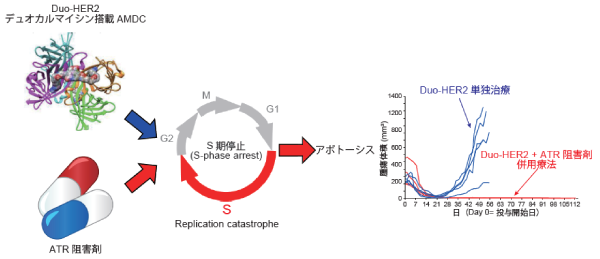
図1 Duo-HER2とATR阻害剤の併用による合成致死誘導作用
<関連情報>
- https://www.iwate-med.ac.jp/news/n5-research/26071001-kouhou/
- https://www.iwate-med.ac.jp/wp/wp-content/uploads/a0a6b1db3fe35b1e5e9aa5cd2f6c8365.pdf
デュオカルマイシン含有抗体模倣薬物複合体とATR阻害剤の併用により、KPL-4異種移植モデルにおいて腫瘍の完全退縮が認められた Duocarmycin-Bearing Antibody-Mimetic Drug Conjugate Combined With an ATR Inhibitor Results in Complete Tumor Regression in a KPL-4 Xenograft Model
Toshiya Tanaka, Akira Sugiyama, Juri Sakata, Toshifumi Tatsumi, Hiroto Katoh, Keisuke Maeda, Yuya Inagaki, Takefumi Yamashita, Takeshi Kawamura, Mayu Kuratani, Taiki Nakano, …
Cancer Medicine Published: 06 July 2026
DOI:https://doi.org/10.1002/cam4.72071
ABSTRACT
Antibody–drug conjugates (ADCs) have demonstrated superior clinical outcomes in patients with HER2-positive advanced breast cancer compared with previous treatment modalities. However, resistance and treatment-limiting toxicities frequently emerge during repeated administration, underscoring an unmet need for strategies to overcome ADC failure. In this study, we investigated whether inhibition of ataxia telangiectasia and Rad3-related protein (ATR) could enhance the antitumor efficacy of antibody-mimetic drug conjugates (AMDCs), a targeted payload delivery platform. Combination treatment with a duocarmycin-bearing HER2-targeted AMDC (Duo-HER2) and an ATR inhibitor markedly enhanced antitumor activity in a human HER2-positive breast cancer xenograft model. In a limited cohort of treated mice, this combination induced sustained tumor suppression, with prolonged tumor-free survival exceeding 100 days. Although transient body weight loss was observed during the early phase of treatment, no evidence of overt systemic toxicity was detected. Synergistic interactions with Duo-HER2 were further confirmed in vitro using three clinically relevant ATR inhibitors—tuvusertib, ceralasertib, and berzosertib. Short-term apoptosis analyses revealed only modest induction of cell death, whereas longer-term viability assays demonstrated pronounced growth suppression. Cell cycle analyses showed S-phase accumulation accompanied by a mild increase in the sub-G1 population, suggesting that the combination initially exerts a cytostatic effect through replication stress–induced S-phase arrest, followed by delayed cytotoxicity. Together, these findings indicate that Duo-HER2 combined with ATR inhibitors synergistically suppresses tumor growth in HER2-positive breast cancer models. Further studies employing optimized formulations, expanded in vivo cohorts, and additional tumor models will be required to fully define the therapeutic potential of this strategy and its relevance for overcoming ADC resistance.