
2026-09-25 カロリンスカ研究所(KI)
<関連情報>
- https://news.ki.se/dietary-patterns-linked-to-favourable-blood-biomarkers-relevant-to-ageing
- https://link.springer.com/article/10.1186/s12916-026-05202-2
高齢者の食習慣の生物学的特徴:集団ベースの研究からの知見 Biological signature of dietary patterns in older adults: findings from a population-based study
Rachel Ann DaCosta, Caterina Gregorio, Amaia Calderón-Larrañaga, Alice Margherita Ornago, Anja Mrhar, Rosario Ortolá, Claudia Fredolini, Davide Liborio Vetrano & Adrián Carballo-Casla
BMC Medicine Published:15 September 2026
DOI:https://doi.org/10.1186/s12916-026-05202-2
Abstract
Background
Diet quality is a key modifiable factor influencing age-related health outcomes, yet its impact on the biological mechanisms involved in the aging process is not fully understood. This study aimed to identify the blood-based biomarkers most strongly associated with adherence to diverse dietary patterns and to describe the pathophysiological domains they belong to.
Methods
We analysed data from 1,769 participants aged ≥ 60 years from the population-based Swedish National Study on Aging and Care in Kungsholmen. Dietary intake was assessed using validated food frequency questionnaires. Diet quality was evaluated using adherence to the Alternative Mediterranean Diet (AMED), the Alternative Healthy Eating Index (AHEI), and the reverse-transformed Empirical Dietary Inflammatory Index (rEDII). Fifty-four blood biomarkers spanning metabolic, inflammatory, vascular, and neurodegenerative domains were analysed. Cross-sectional associations between adherence to the dietary patterns and standardized biomarker levels were examined using quantile regression, adjusted for sociodemographic and lifestyle factors.
Results
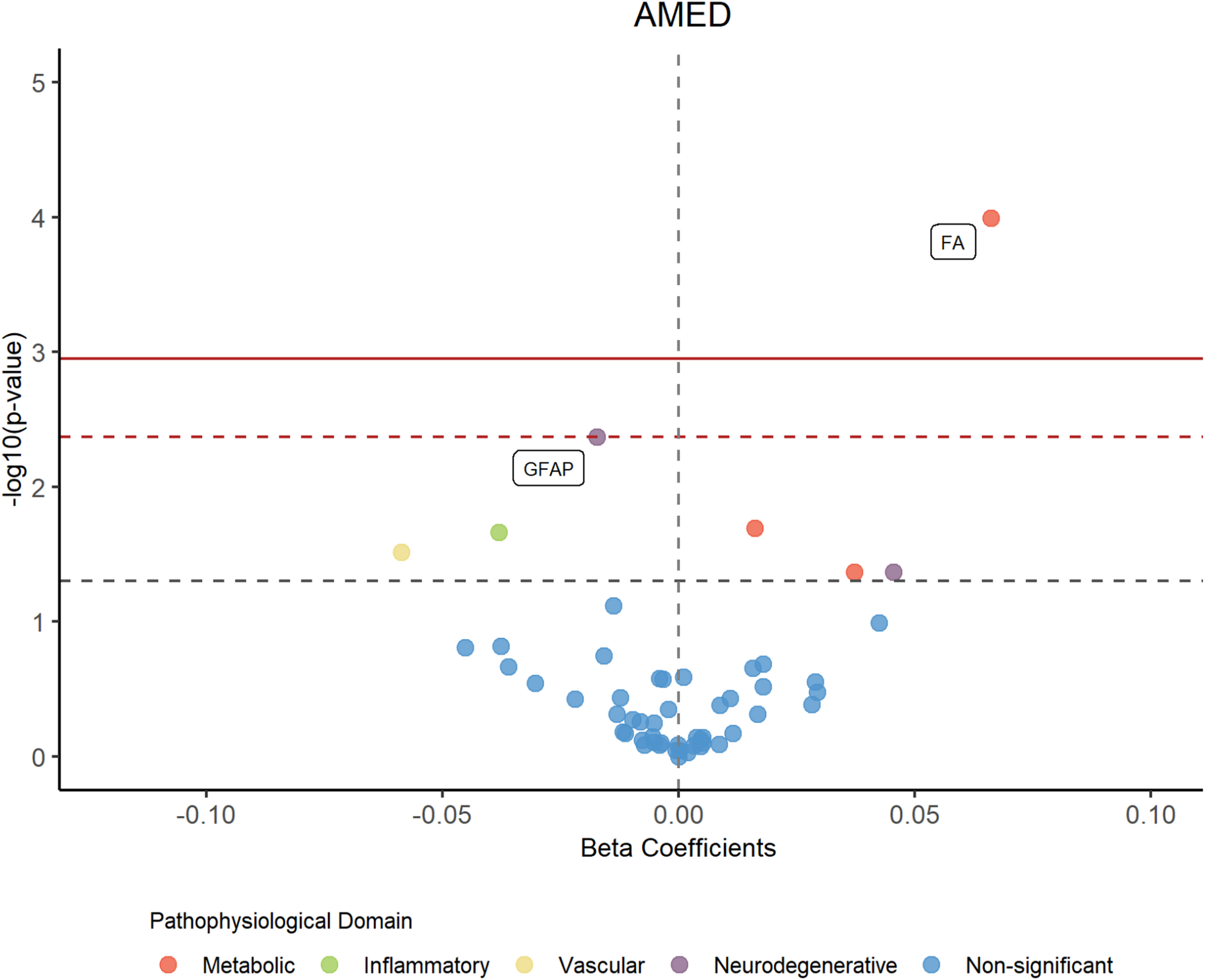
After multiple comparison correction, at the median level of each biomarker distribution, higher adherence (1 standard deviation increment) to the AMED was directly associated with folic acid levels [beta coefficient (95% confidence interval) = 0.066 (0.033, 0.099)] and inversely with glial fibrillary acidic protein [-0.018 (-0.030, -0.006)]. Higher AHEI adherence showed direct association with folic acid levels [0.068 (0.035,0.100)] and inverse with growth differentiation factor 15 levels [-0.063 (-0.098, -0.029)]. Higher adherence to the rEDII was inversely associated with leptin [-0.094 (-0.139, -0.049)], insulin [-0.086 (-0.130, -0.043)], growth differentiation factor 15 [-0.064 (-0.100, -0.027)], alkaline phosphatase [-0.078 (-0.122, -0.033)], tumour necrosis factor receptor superfamily member 1B [-0.047 (-0.076, -0.019)], and leukocytes [-0.058 (-0.092, -0.024)]. Associations remained consistent across multiple sensitivity analyses.
Conclusions
Higher diet quality is associated with favourable levels of blood-based biomarkers in older adults, with distinct associations within the metabolic and inflammatory domains, supporting the role of diet in promoting healthier aging.

