2025-06-17 東京大学
<関連情報>
- https://www.u-tokyo.ac.jp/focus/ja/press/z0111_00080.html
- https://www.u-tokyo.ac.jp/content/400265923.pdf
- https://elifesciences.org/articles/99650
ショウジョウバエ嗅覚受容体ニューロンの非致死的活性化を促進するファシクリン3の近傍に実行因子カスパーゼが存在する Executioner caspase is proximal to Fasciclin 3 which facilitates non-lethal activation in Drosophila olfactory receptor neurons
Masaya Muramoto,Nozomi Hanawa,Misako Okumura,Takahiro Chihara,Masayuki Miura,Natsuki Shinoda
eLife Published:Jun 17, 2025
DOI:https://doi.org/10.7554/eLife.99650.3
Abstract
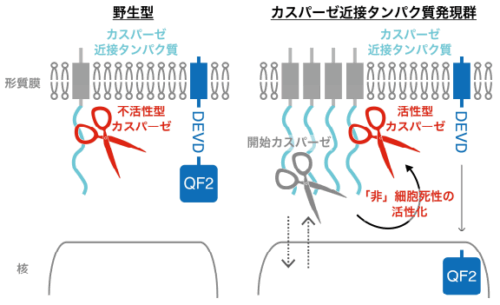
The nervous system undergoes functional modification independent of cell turnover. Caspase participates in reversible neuronal modulation via non-lethal activation. However, the mechanism that enables non-lethal activation remains unclear. Here, we analyzed proximal proteins of Drosophila executioner caspase in the adult brain using TurboID. We discovered that executioner caspase Drice is, as an inactive proform, proximal to cell membrane proteins, including a specific splicing isoform of cell adhesion molecule Fasciclin 3 (Fas3), Fas3G. To investigate whether sequestration of executioner caspase to plasma membrane of axons is the mechanism for non-lethal activation, we developed a Gal4-Manipulated Area-Specific CaspaseTracker/CasExpress system for sensitive monitoring of caspase activity near the plasma membrane. We demonstrated that Fas3G overexpression promotes caspase activation in olfactory receptor neurons without killing them, by inducing expression of initiator caspase Dronc, which also comes close to Fas3G. Physiologically, Fas3G overexpression-facilitated non-lethal caspase activation suppresses innate olfactory attraction behavior. Our findings suggest that subcellularly restricted caspase activation, defined by caspase-proximal proteins, is the mechanism for non-lethal activation, opening the methodological development of reversible modification of neuronal function via regulating caspase-proximal proteins.