2025-06-23 インペリアル・カレッジ・ロンドン(ICL)
<関連情報>
- https://www.imperial.ac.uk/news/265333/food-structure-plays-role-which-hormones/
- https://www.nature.com/articles/s42255-025-01309-7
上部消化管代謝物プロファイルは対照的な構造の食事に対する血糖および満腹感反応を制御する:パイロット研究 Upper-gastrointestinal tract metabolite profile regulates glycaemic and satiety responses to meals with contrasting structure: a pilot study
Mingzhu Cai,Shilpa Tejpal,Martina Tashkova,Peter Ryden,Natalia Perez-Moral,Shikha Saha,Isabel Garcia-Perez,Jose Ivan Serrano Contreras,Julien Wist,Elaine Holmes,Andres Bernal,Bowen Dou,Georgia Franco Becker,Gary Frost & Cathrina Edwards
Nature Metabolism Published:20 June 2025
DOI:https://doi.org/10.1038/s42255-025-01309-7
Abstract
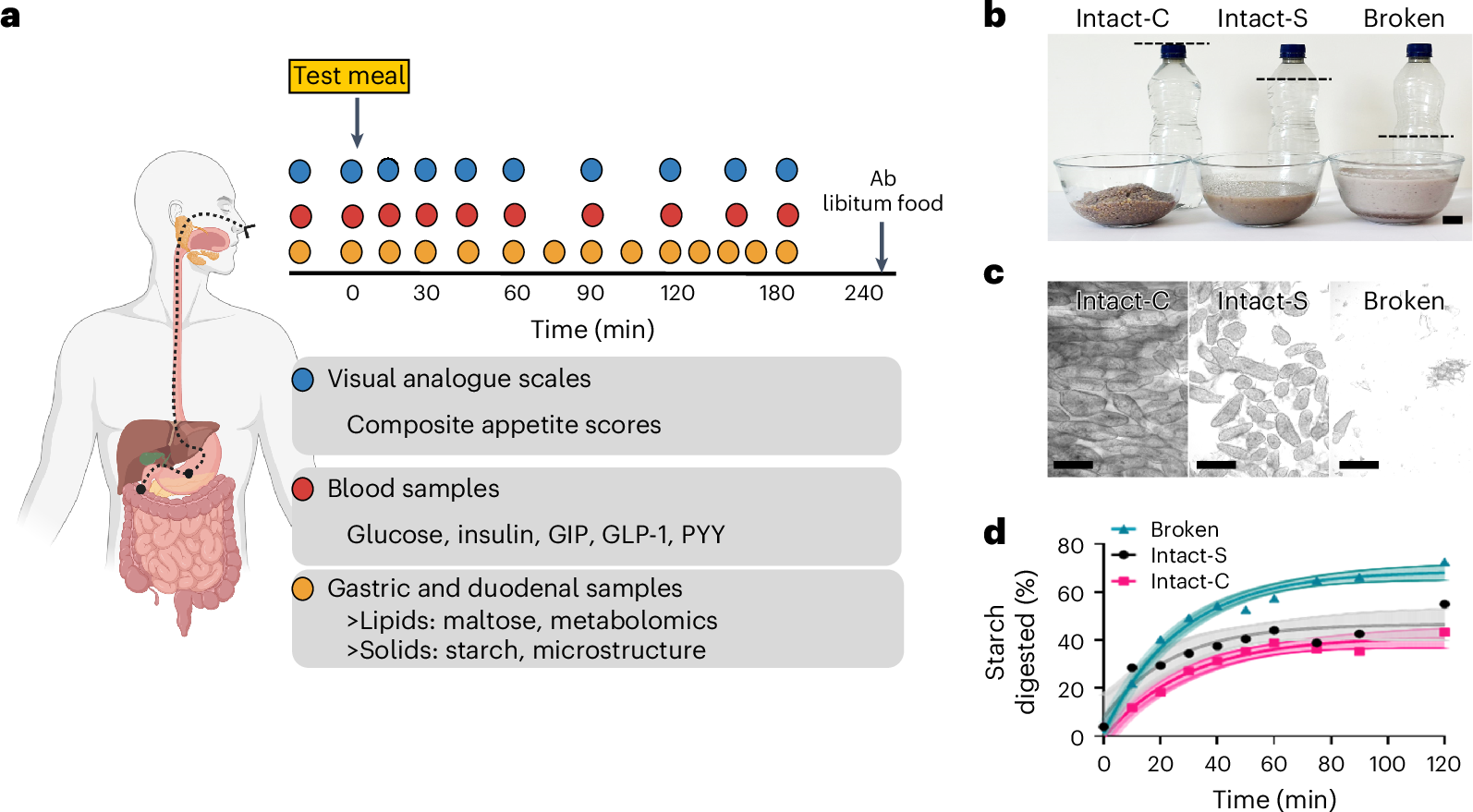
Dietary interventions to combat non-communicable diseases focus on optimizing food intake but overlook the influence of food structure. Here, we investigate how food structure influences digestion. In a randomized crossover study, ten healthy participants were fitted with nasoenteric tubes that allow simultaneous gastric and duodenal sampling, before consuming iso-nutrient chickpea meals with contrasting cellular structures. The primary outcome is gut hormone response. Secondary outcomes are intestinal content analysis, blood glucose and insulin response, subjective appetite changes and ad libitum energy intake. We show that the ‘Broken’ and ‘Intact’ cell structures of meals result in different digestive and metabolomic profiles, leading to distinct postprandial gut hormones, glycaemia and satiety responses. ‘Broken’ meal structure elicits higher glucose-dependent insulinotropic peptide, glucagon-like peptide-1 and blood glycaemia, driven by high starch digestibility and a sharp rise in gastric maltose within 30 min. ‘Intact’ meal structure produces a prolonged release of glucagon-like peptide-1 and peptide-YY, elevated duodenal amino acids and undigested starch at 120 min. This work highlights how food structure alters upper gastrointestinal nutrient-sensing hormones, providing insights into the adverse effects of modern diets on obesity and type 2 diabetes. ISRCTN registration: ISRCTN18097249.