2025-06-25 ミュンヘン大学(LMU)
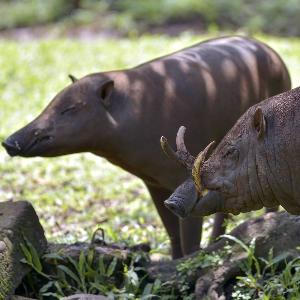
The critically endangered babirusas belong to the pig family. | © IMAGO / Cavan Images
<関連情報>
- https://www.lmu.de/en/newsroom/news-overview/news/endangered-mammals-populations-on-small-islands-are-genetically-healthier.html
- https://www.pnas.org/doi/10.1073/pnas.2422690122
絶滅の危機に瀕する大型島嶼哺乳類の長期生存における小島嶼個体群の重要性 The importance of small-island populations for the long-term survival of endangered large-bodied insular mammals
Sabhrina Gita Aninta, Rosie Drinkwater, Alberto Carmagnini, +23 , and Laurent Frantz
Proceedings of the National Academy of Sciences Published:June 24, 2025
DOI:https://doi.org/10.1073/pnas.2422690122
Significance
Within tropical archipelagos, such as the Wallacea biodiversity hotspot, larger islands experience greater resource exploitation compared to smaller ones, highlighting the potential of smaller islands as refuges for conservation. To investigate the genetic health of populations on small islands, we used genomic, occurrence, and environmental data from a system of replicated populations of anoa and babirusa across islands of varying sizes. In contrast to larger islands like Sulawesi, our results demonstrate that smaller offshore islands not only provide higher-quality habitats but also support populations that have efficiently purged harmful mutations. Thus, despite their known vulnerability over geological time-frames, small-island populations can provide long-term insurance against human-driven extinction and conservation efforts should prioritize habitat management over translocations.
Abstract
Island populations of large vertebrates have experienced higher extinction rates than mainland populations over long timescales due to demographic stochasticity, genetic drift, and inbreeding. While being more susceptible to extinction and as such potentially targeted for conservation interventions such as genetic rescue, small-island populations can experience relatively less anthropogenic habitat degradation than those on larger islands. Here, we determine the consequences and conservation implications of long-term isolation and recent human activities on genetic diversity of island populations of two forest-dependent mammals endemic to the Wallacea archipelago: the anoa (Bubalus spp.) and babirusa (Babyrousa spp.). Using genomic analyses and habitat suitability models, we show that, compared to closely related species, populations on mainland Sulawesi exhibit low heterozygosity, high inbreeding, a high proportion of deleterious alleles, and experience a high rate of anthropogenic disturbance. In contrast, populations on smaller islands occupy higher-quality habitats, possess fewer deleterious mutations despite exhibiting lower heterozygosity and higher inbreeding. Site frequency spectra indicate that these patterns reflect stronger, long-term purging in smaller-island populations. Our results thus suggest that conservation efforts should focus on protecting small-island high-quality habitats and avoiding translocations from mainland populations. This study highlights the crucial role of small offshore islands for the long-term survival of Wallacea’s iconic and indigenous mammals in the face of development on the mainland.