
2025-07-02 京都大学iPS細胞研究所
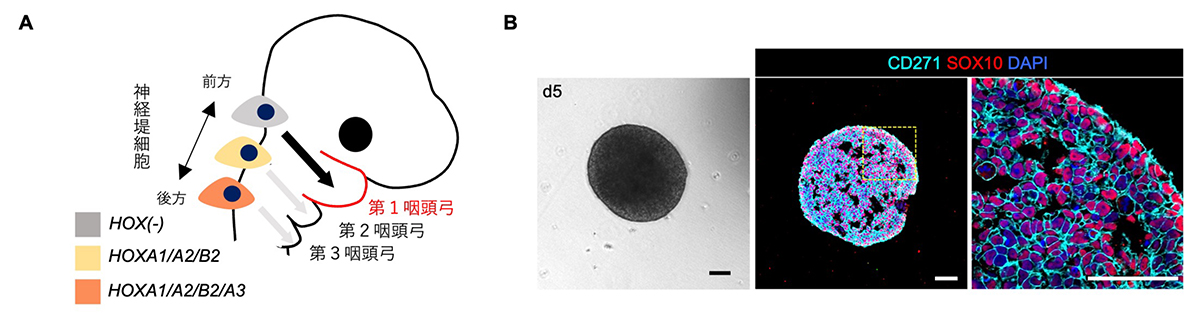 図1. ヒトiPS細胞からHOX遺伝子発現のない神経堤細胞を3次元培養で作製
<関連情報>
- https://www.cira.kyoto-u.ac.jp/j/pressrelease/news/250702-180000.html
- https://www.nature.com/articles/s41551-025-01419-3
ヒト多能性幹細胞から顎骨様オルガノイドが作製される Jawbone-like organoids generated from human pluripotent stem cells
Souta Motoike,Yoshiko Inada,Junya Toguchida,Mikihito Kajiya & Makoto Ikeya
Nature Biomedical Engineering Published:02 July 2025
DOI:https://doi.org/10.1038/s41551-025-01419-3
Abstract
Engineering jawbone tissues from pluripotent stem cells presents a challenge owing to the lack of protocols for selectively inducing the jawbone progenitor, the first pharyngeal arch (PA1) ectomesenchyme, and for recapitulating three-dimensional osteocyte networks. Here we present a method for generating jawbone-like organoids from human induced pluripotent stem cells through PA1 ectomesenchyme of the mandibular prominence (mdEM). A three-dimensional culture system enables sequential differentiation of induced pluripotent stem cells into neural crest cells and mdEM. The mdEM exhibits proximal–distal patterning from the centre outwards, mirroring mandibular development. The introduction of exogenous pharyngeal epithelial signals induces mandibular prominence-specific regional patterning in the mdEM. When cultured under osteogenic conditions, the mdEM forms jawbone-like organoids comprising osteoblasts and network-forming osteocytes embedded in self-produced mineralized bone matrices. Moreover, these organoids promote bone regeneration when transplanted into jaws containing bone defects and recapitulate phenotypes of osteogenesis imperfecta, a genetic disorder characterized by fragile bones, using patient-derived induced pluripotent stem cells. Our protocols establish a foundation for investigating human jaw embryology and pathophysiology.
00439-8/asset/0c1c92bd-32f4-4cdc-a101-52a38bc6e8f8/main.assets/gr1_lrg.jpg "心房細動を伴う脳梗塞の再発防止には発症4日以内の抗凝固薬開始が有用~脳梗塞の診療ガイドライン推奨内容の改訂につながる成果~")