2025-06-30 中国科学院(CAS)
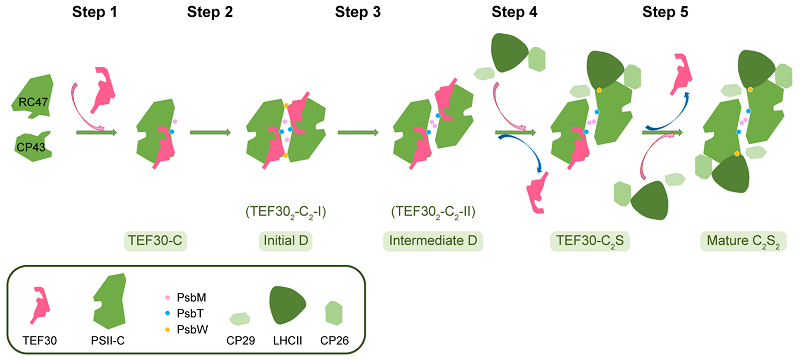
A proposed molecular model for the TEF30-mediated mechanism of the mid-to-late stage PSII repair process (Image by LIU Zhenfeng’s group)
<関連情報>
- https://english.cas.cn/newsroom/research_news/life/202507/t20250707_1046911.shtml
- https://www.nature.com/articles/s41477-025-02036-3
クラミドモナス(Chlamydomonas reinhardtii)における光化学系IIの修復と再構築における複数のTEF30関連中間体複合体の役割 Roles of multiple TEF30-associated intermediate complexes in the repair and reassembly of photosystem II in Chlamydomonas reinhardtii
Yidi Wang,Chenxi Wang,Anjie Li & Zhenfeng Liu
Nature Plants Published:27 June 2025
DOI:https://doi.org/10.1038/s41477-025-02036-3
Abstract
During oxygenic photosynthesis, photosystem II (PSII) uses light energy for oxidizing water and reducing plastoquinone. It is susceptible to photodamage, and the damaged PSII is repaired through a sophisticated biological process assisted by numerous auxiliary proteins. Here we report the cryogenic electron microscopy structures of four PSII-repair complexes from Chlamydomonas reinhardtii associated with the Thylakoid Enriched Fraction 30 (TEF30, an orthologue of plant MET1) protein—namely, a TEF30–PSII core monomer (TEF30-C), two types of TEF30–PSII core dimers (types I and II, TEF302-C2-I and TEF302-C2-II) and a TEF30-C2S-type PSII–LHCII supercomplex (TEF30-C2S; S, strongly associated light-harvesting complex II trimer). TEF30 mediates the assembly of CP43 with the RC47 module by clamping on the stromal surfaces and prevents the premature association of peripheral antennae with PSII-C. In the transition from TEF302-C2-I to TEF302-C2-II, TEF30-C2S and mature C2S2, one PSII core slides along the dimerization interface against the adjacent one by 22–35 Å, generating a zigzagged surface for accommodating the peripheral antennae. These results suggest that the PSII repair process undergoes multiple TEF30-mediated intermediate states to form intact PSII–LHCII supercomplexes.