2025-07-08 スイス連邦工科大学ローザンヌ校(EPFL)
<関連情報>
- https://actu.epfl.ch/news/the-multitasking-microbe-that-turns-naturally-co2-/
- https://www.nature.com/articles/s41598-025-07323-9
バチルス・メガテリウム(Bacillus megaterium)は、尿分解経路よりもCO₂のCaCO₃への無機化を好む Bacillus megaterium favours CO₂ mineralization into CaCO₃ over the ureolytic pathway
Margherita Cappa,Camilla Perego,Dimitrios Terzis & Pamela Principi
Scientific Reports Published:01 July 2025
DOI:https://doi.org/10.1038/s41598-025-07323-9
Abstract
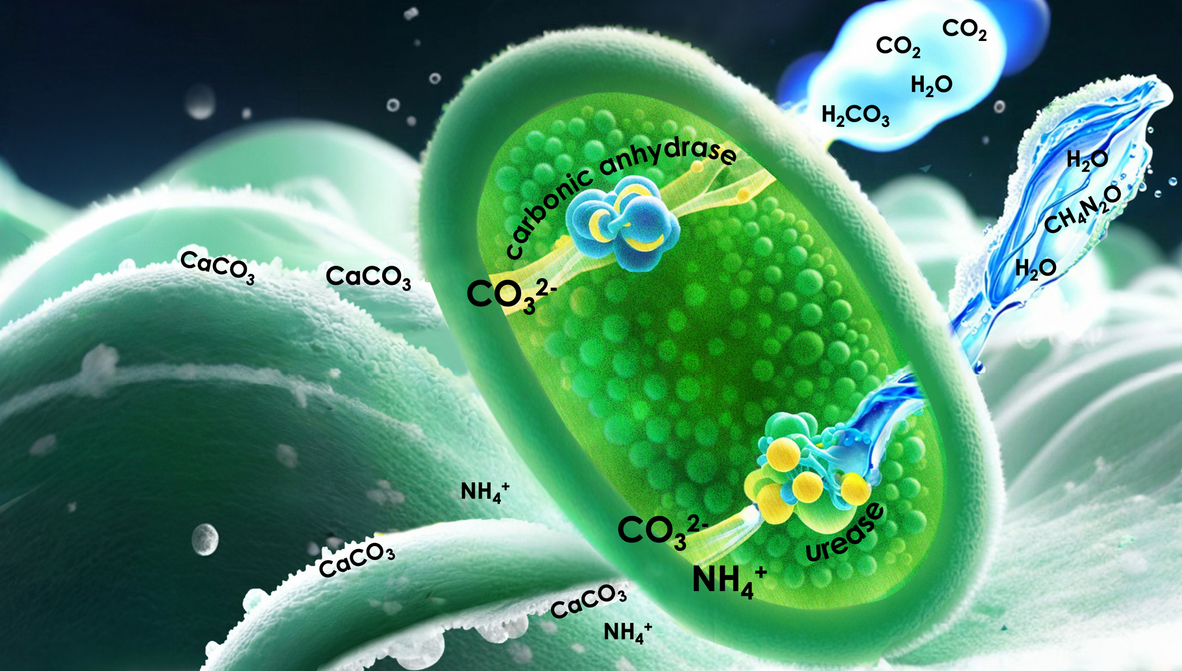
Microbially induced calcite precipitation (MICP) has long been the focus of material scientists, environmental microbiologists and civil engineers because of its potential to yield biosynthesized binders that can serve as alternatives to cement or resins. Several microbial strains play crucial roles in this process and catalyse pathways for the formation of minerals, which are believed to substantially reduce the environmental impact of building materials and activities. Among the studied strains, Bacillus megaterium is not as common as Sporosarcina species. The latter microorganisms are well known to drive the fastest ureolytic-driven MICP process, i.e., precipitation of CaCO3 after urea breakdown into carbonate and CaCl2 addition to the system. This paper sheds light on the activities of B. megaterium, which possesses dual enzymatic capabilities for MICP and is equipped with both the enzymes urease and carbonic anhydrase. We postulate that, depending on the growth conditions, B. megaterium can activate either of these genes to ultimately induce CaCO3 precipitation. Herein, experiments are carried out in open and closed systems. C13-labelled urea is employed to identify the carbon source in the precipitated CaCO3. The results from Fourier transform infrared spectroscopy (FTIR) revealed the precipitation of calcite. In the presence of urea and CO2 at atmospheric levels, B. megaterium activates the ureolytic pathway to perform urea hydrolysis. However, at increased CO2 levels, more precisely, at levels greater than 470 times the atmospheric level, carbonic anhydrase is activated, catalysing the hydration of the molecule to produce HCO3–. When C13-labelled urea was utilized, only 6% of the precipitated CaCO3 mineral was linked to ureolysis, and it was found that the remaining 94% was formed due to the mineralization of CO2. Overall, in this work, we aim to introduce the process conditions and protocols that favour the sequestration of atmospheric CO2 as CaCO3 via the metabolic activities of B. megaterium.