2025-07-22 京都大学
<関連情報>
- https://www.kyoto-u.ac.jp/ja/research-news/2025-07-22
- https://www.kyoto-u.ac.jp/sites/default/files/2025-07/2507_BMC-EcoEvo_Murayama_web-58ea11b0e692346a468d8867ad51a6db.pdf
- https://bmcecolevol.biomedcentral.com/articles/10.1186/s12862-025-02412-9
沖縄で移入されたオオヒキガエルを捕食するカンムリワシにおけるNa+/K+-ATPaseを介した毒素耐性に関する進化的洞察 Evolutionary insights into Na+/K+-ATPase-mediated toxin resistance in the Crested Serpent-eagle preying on introduced cane toads in Okinawa, Japan
Alisa Tobe,Yu Sato,Mitsuki Kondo,Manabu Onuma & Miho Inoue-Murayama
BMC Ecology and Evolution Published:14 July 2025
DOI:https://doi.org/10.1186/s12862-025-02412-9
Abstract
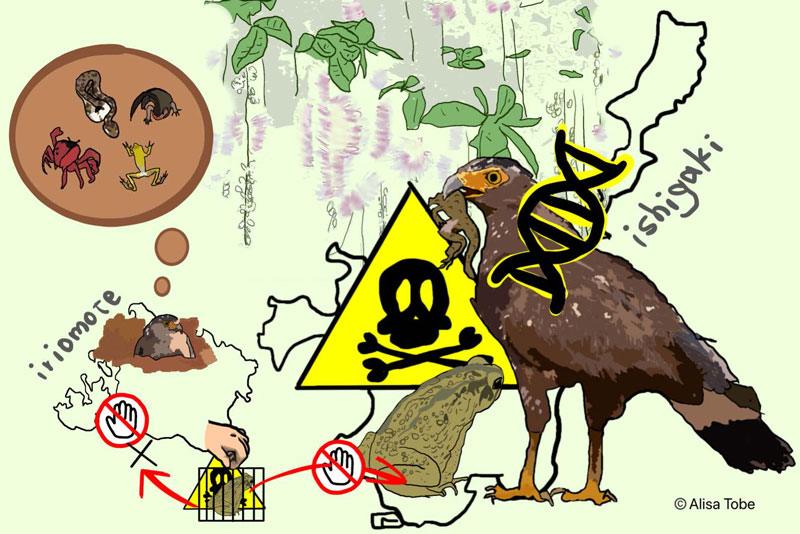
Prey species often develop toxic chemical defenses against predators, prompting predators to evolve traits that counteract these toxins. A prime example of this evolutionary arms race involves resistance to lethal cardiotonic steroids, which is associated with specific amino acid mutations in the α-subunit of Na+/K+-ATPase (ATP1A) across diverse predator species. The Japanese Crested Serpent-eagle (Spilornis cheela perplexus), which is endemic to the adjacent islands of Ishigaki and Iriomote in Okinawa, provides an intriguing example of this convergent evolution. This eagle preys on cane toads (Rhinella marina), an invasive species anthropogenically introduced only to Ishigaki Island, which defends itself by secreting cardiotonic steroids. Notably, no native prey species of the Crested Serpent-eagle on Ishigaki or Iriomote Island secrete cardiotonic steroids as a defense mechanism. To investigate the genetic and evolutionary background of potential toxin resistance in this eagle, we analyzed the genetic population structure and ATP1A gene sequences from individuals on Ishigaki and Iriomote Islands, as well as from the subspecies population on Simeulue Island, Indonesia. Whole-genome analysis revealed significant genetic isolation among the three island populations. However, the amino acid sequences of ATP1A paralogs were identical across all populations. Notably, the Q111E amino acid mutation in ATP1A1, which is associated with toxin resistance in other species, was detected in this eagle. A comparative analysis of ATP1A amino acid sequences across nine raptor species revealed that the Crested Serpent-eagle and Black-chested Snake Eagle (Circaetus pectoralis), both of which belong to the subfamily Circaetinae, share similar sequences that are distinct from those of other raptors. These findings indicate that possible lineage-specific adaptations in ATP1A provide the Crested Serpent-eagle with resistance to cardiotonic steroids. The conservation of this adaptive gene within species might have origins unrelated to the recent distribution of cardiotonic steroid-secreting prey but has coincidentally enabled the Crested Serpent-eagle on Ishigaki Island to prey on invasive species introduced by humans.