2025-07-22 中国科学院(CAS)
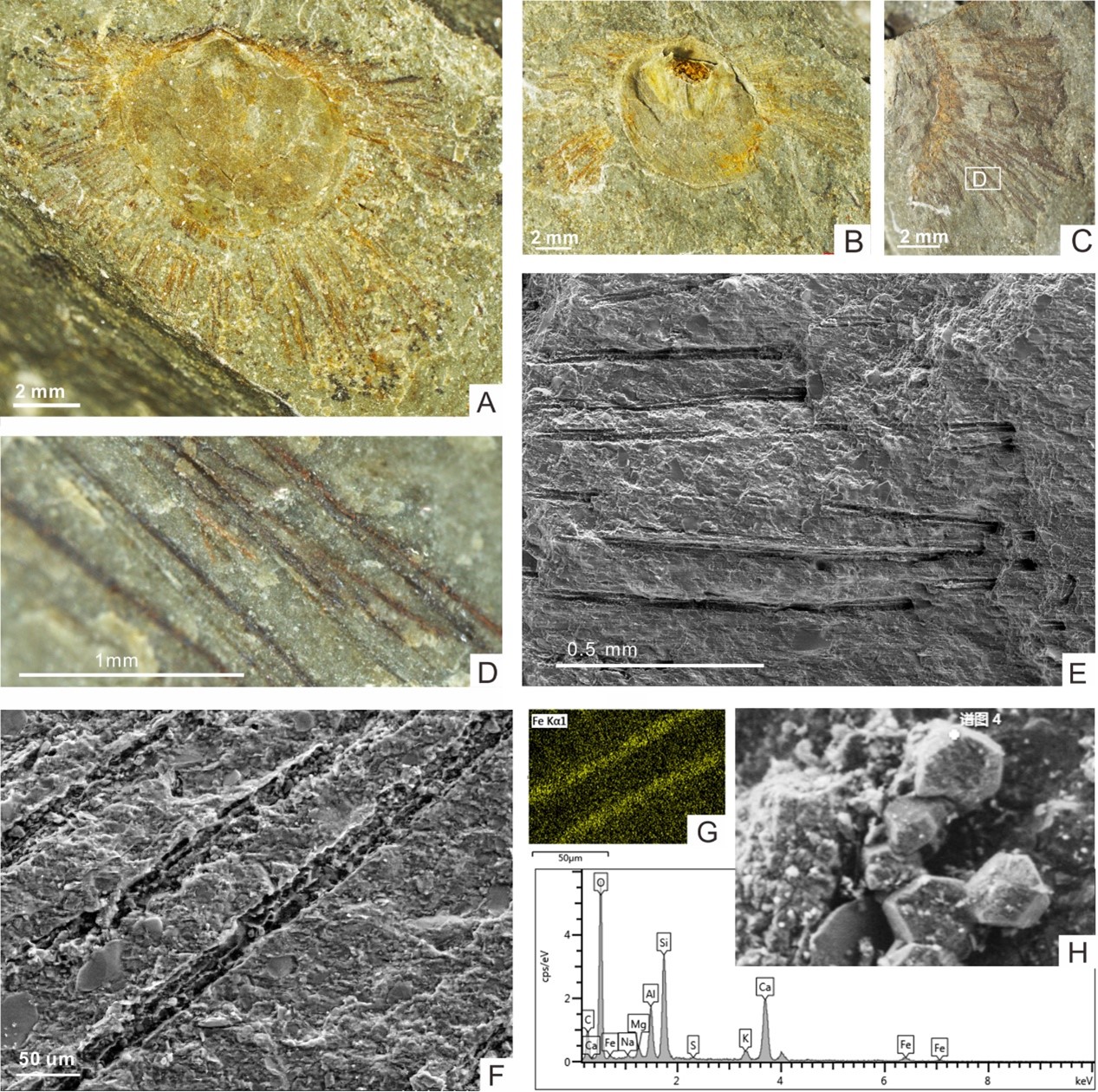
The brachiopod Nucleospira calypta and its setae preserved as iron oxides: interior mold of the ventral valve and close-ups of setae (A–D), together with SEM images and EDS spectra (E–H). (Image by Prof. HUANG Bing)
<関連情報>
- https://english.cas.cn/newsroom/research_news/earth/202507/t20250721_1047731.shtml
- https://www.pnas.org/doi/10.1073/pnas.2509354122
古代の海底チェッカーボード: シルル紀腕足類の空間分布はどのようにして形成されたか? Ancient seabed checkerboard: How setae shaped spatial distributions of Silurian brachiopods
Bing Huang and Jiayu Rong
Proceedings of the National Academy of Sciences Published:July 21, 2025
DOI:https://doi.org/10.1073/pnas.2509354122
Significance
Small anatomical details can significantly influence how marine animals organize themselves, yet such interactions are rarely visible in fossils. We report exceptionally preserved soft, bristle-like structures (“setae”) on 436-My-old brachiopods, enabling analysis of ancient behavior. Using advanced imaging and statistical analysis, we identified a regular, checkerboard-like spacing pattern among these organisms, closely corresponding to their setae length. This demonstrates that these delicate structures played an important role in maintaining spacing between individuals, thereby influencing population organization on the ancient seabed. Our findings point to a previously unrecognized mechanism shaping ecosystem structure in deep time, demonstrating how subtle anatomical features could exert notable ecological impacts in their ancient environments.
Abstract
Understanding the drivers of spatial patterns in fossil communities is fundamental to paleoecology, yet direct evidence for biological mechanisms regulating interindividual spacing remains elusive. Brachiopod setae, hypothesized to function in feeding or defense, are exceedingly rare in the fossil record, especially among post-Cambrian taxa. Here, we present the report of exquisitely preserved setae from an exceptional in situ fossil assemblage of the early Silurian rhynchonelliform brachiopod Nucleospira calypta. Multiproxy analyses (scanning electron microscopy, X-ray fluorescence, and microcomputed tomography) revealed intricate ultrastructural details and diverse taphonomic pathways, leading to a reinterpretation of apparent calcitic preservation as primarily iron oxides with subsequent coating. Critically, the undisturbed nature of this aggregation allowed rigorous spatial point pattern analysis (Nearest-Neighbor Analysis, Thiessen polygons). This revealed a statistically significant, nonrandom, checkerboard-like distribution among individuals within the studied fossil deposit, indicative of active spacing regulation. Strikingly, the measured average interindividual spacing quantitatively relates to the length of the preserved setae. This provides the direct paleontological evidence demonstrating that these subtle morphological structures could have actively mediated spatial organization within a dense benthic community. Our findings illustrate a biological mechanism capable of shaping community structure, operating beyond passive environmental constraints or initial larval settlement preferences, and highlight the potential for subtle anatomical features to exert significant ecological influence in deep time.