2025-08-07 基礎生物学研究所
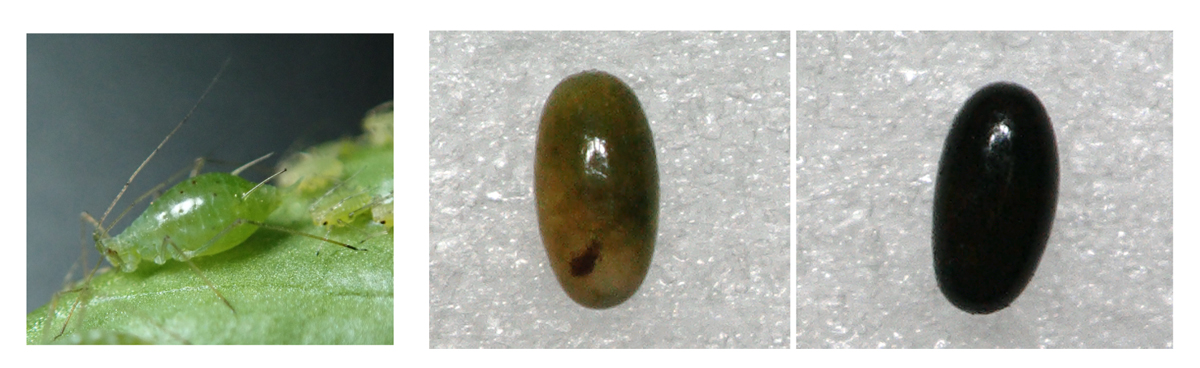
左図:エンドウヒゲナガアブラムシ [写真提供:野崎友成]
右図:本研究で最適化したCRISPR/Cas9ゲノム編集法によりLaccase2(ラッカーゼ2)遺伝子をノックアウトした卵(左)。真っ黒にメラニン色素が沈着している野生型の卵(右)に比べて、ノックアウト卵(左)は卵殻の色素が消失し、中の胚が透けて見える。
<関連情報>
- https://www.nibb.ac.jp/press/2025/08/07.html
- https://journals.plos.org/plosgenetics/article?id=10.1371/journal.pgen.1011557
エンドウアブラムシにおける精巧なCRISPR/Cas9ゲノム編集により、Laccase2が越冬卵の適応に不可欠な役割を果たすことが明らかになった Refined CRISPR/Cas9 genome editing in the pea aphid uncovers the essential roles of Laccase2 in overwintering egg adaptation
Shuji Shigenobu ,Shinichi Yoda ,Sonoko Ohsawa,Miyuzu Suzuki
PLOS Genetics Published: July 21, 2025
DOI:https://doi.org/10.1371/journal.pgen.1011557
Abstract
The production of overwintering eggs is a critical adaptation for winter survival among many insects. Melanization contributes to eggshell pigmentation and hardening, consequently enhancing resistance to environmental stress. The complex life cycle of the pea aphid (Acyrthosiphon pisum), a model hemipteran insect with remarkable reproductive capacity, involves cyclical parthenogenesis. It enables the production of black overwintering eggs that undergo obligate diapause to survive under unfavorable conditions. Laccase2 (Lac2) is essential for cuticle sclerotization and pigmentation in other insects. We hypothesized that Lac2 plays a critical role in aphid eggshell pigmentation and survival during diapause. To test the hypothesis, we used CRISPR/Cas9 ribonucleoprotein microinjections and a novel Direct Parental CRISPR (DIPA-CRISPR) method to knockout Lac2. In Lac2 knockout (KO) crispants (G0), pigment-less eggs correlated with induced indel rates. Additionally, eggshell pigmentation was completely lost in homozygous Lac2 knockouts, leading to embryonic lethality. Observation of late-stage embryos in KO diapause eggs suggested that lethality occurred during late embryogenesis or hatching. Furthermore, eggshell stiffness was significantly reduced in Lac2 KOs, highlighting the role of this gene in eggshell hardening. Moreover, fungal growth was observed in KO eggs. These findings reveal the essential roles of Lac2 in eggshell pigmentation, hardening, late embryonic development, hatching, and fungal protection, which are critical for pea aphid survival during overwintering diapause. This study also advances CRISPR/Cas9-mediated genome editing in pea aphids by addressing the challenges associated with their unique biology, including complex life cycles, obligatory diapause, bacterial endosymbiosis, inbreeding depression, and high nuclease activity. Our optimized protocol achieved efficient targeted mutagenesis and germline transmission, thereby generating stable KO lines. Additionally, we successfully applied DIPA-CRISPR to aphids by inducing mutations via adult oviparous female injections in fertilized eggs. These robust genome-editing protocols will facilitate functional studies in aphids, a key model for research on evolution, ecology, development, and agriculture.
Author summary
Surviving harsh winters is a challenge for many insects, and the production of specialized overwintering eggs is a common adaptation strategy. These eggs are protected from cold, desiccation, and fungal infections by their hardened, pigmented shells. The pea aphid, a hemipteran insect with a complex life cycle, relies on these eggs to survive winter. Aphids alternate between asexual reproduction in the warmer months and sexual reproduction in the fall, producing overwintering eggs that remain dormant until spring. In this study, we explored the role of Laccase2 (Lac2), a key gene that contributes to the strengthening and darkening of insect exoskeletons. We disrupted Lac2 in pea aphids using advanced genome-editing techniques, including a new approach called DIPA-CRISPR. This resulted in pigment-free eggs with weakened shells that were more prone to fungal infections and failed to hatch. This demonstrates that Lac2 is essential for the survival of overwintering eggs. In addition, we refined the CRISPR/Cas9 genome editing methods for pea aphids, enabling efficient and precise genetic studies. These findings and the tools we developed can facilitate research on ecology, evolution, and pest control, while shedding light on how insects adapt to challenging environments.