2025-07-28 名古屋市立大学
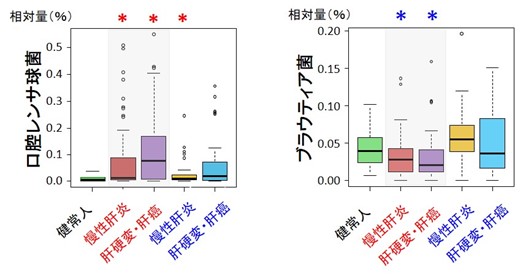
図1 C型肝炎ウイルス(HCV)排除前後における腸内細菌の変化
<関連情報>
- https://www.nagoya-cu.ac.jp/press-news/202507281000/
- https://www.nagoya-cu.ac.jp/media/202507281000press.pdf
- https://www.jhep-reports.eu/article/S2589-5559(25)00172-7/fulltext
C型肝炎ウイルス排除後の腸肝軸の回復 Restoration of the gut-microbiota-liver axis after hepatitis C virus eradication
Takako Inoue ∙ Jiro Nakayama ∙ Hiroshi Mori ∙ … ∙ Atsushi Toyoda ∙ Ken Kurokawa ∙ Yasuhito Tanaka
JHEP Reports Published:June 24, 2025
DOI:https://doi.org/10.1016/j.jhepr.2025.101494
Highlights
•This study investigates the gut-microbiota-liver axis in chronic hepatitis C patients after sustained virological responses (SVR).
•During HCV infection, the classical bile acid biosynthetic pathway is suppressed, leading to a significant reduction in intestinal deoxycholic acid levels that are restored to normal following the achievement of SVR.
•An improvement in liver fibrosis and function is associated with an increase in Blautia species, suggesting a potential connection to liver recovery.
Abstract
Background & Aims
We have reported altered features of the intestinal environment during hepatitis C virus (HCV) infection. Here, we aimed to characterize the gut-microbiota-liver axis in chronic hepatitis C after a sustained virological response (SVR).
Methods
Firstly, 174 patients with HCV infection were enrolled in the cross-sectional study (chronic hepatitis [CH-HCV group, n = 95], and cirrhosis or hepatocellular carcinoma [LC/HCC-HCV group, n = 79]), along with 75 after SVR (CH-SVR [n = 29] and LC/HCC-SVR [n = 46] groups), and 23 healthy individuals. The subsequent longitudinal study involved 49 patients (CH [n = 29] and LC/HCC [n = 20] groups), 24 and 48 weeks after SVR. RNA sequencing was performed for 65 patients with HCV infection, 28 after SVR, and 12 healthy individuals.
Results
The cross-sectional study indicated that, with HCV eradication, the dysbiotic gut microbiota with outgrowth of streptococci recovered partially to the status of healthy individuals, notably the potentially beneficial genus, Blautia. Also, the aberrant fecal bile acid profile was rebalanced, associated with regaining the expression of genes encoding the classical pathway involved in the biosynthesis of cholic and chenodeoxycholic acids. In the longitudinal study, the recovery of liver fibrosis and function after SVR, e.g., the decrease of Fibrosis-4 index and alanine aminotransferase level, specifically correlated with the increase of a commensal genus, Blautia (p <0.0001 and p = 0.0344, respectively), suggesting a positive effect on the resuscitation of the liver.
Conclusion
Gut-microbiota-liver axis is restored following HCV eradication, in which recovery from liver damage is associated with commensal Lachnospiraceae species.