2025-07-31 理化学研究所,農業・食品産業技術総合研究機構,科学技術振興機構
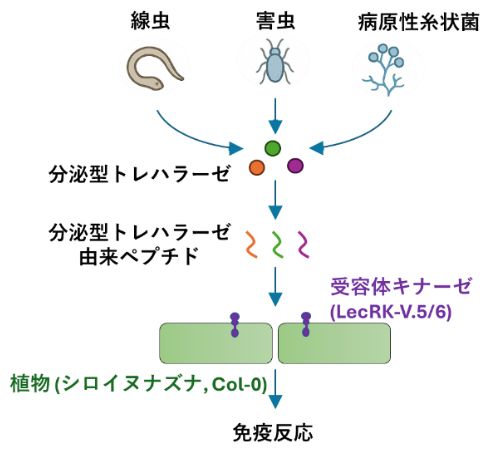
植物による分泌型トレハラーゼを介した植物寄生線虫、害虫、病原性糸状菌の認識機構
<関連情報>
- https://www.riken.jp/press/2025/20250731_1/index.html
- https://www.science.org/doi/10.1126/sciadv.adv8896
トレハロース由来のMAMPが、アラブidopsisにおけるLecRK-V介在型免疫応答を誘発します A trehalase-derived MAMP triggers LecRK-V–mediated immune responses in Arabidopsis
Erika Iino, Yasuhiro Kadota, Noriko Maki, Kazuki Sato, […] , and Ken Shirasu
Science Advances Published:30 Jul 2025
DOI:https://doi.org/10.1126/sciadv.adv8896
Abstract
Plant-parasitic nematodes (PPNs) cause major agricultural losses worldwide, yet the molecular basis of plant immunity against these pathogens remains poorly understood. To investigate how plants recognize PPNs, we aimed to identify microbe-associated molecular patterns (MAMPs) from nematodes and the corresponding plant immune components. Because of the limited availability of material from obligate PPNs, we used Caenorhabditis elegans, a free-living nematode, as a MAMP source. C. elegans extract activated MAMP-triggered immune responses in Arabidopsis Col-0. Through chromatography-based purification, we identified a secreted trehalase and pinpointed a conserved peptide region essential for its MAMP activity. A corresponding peptide from root-knot nematode trehalase enabled the identification of lectin receptor kinases LecRK-V.5 and LecRK-V.6 as key components in immune induction. Notably, this peptide region is conserved across some phytophagous insects and fungal pathogens, with LecRK-Vs required for immune responses to these peptides, highlighting the role of LecRK-V–mediated mechanism for broad-spectrum pathogen detection via trehalase-derived peptides.