2025-07-30 京都大学
京都大学・神戸大学・愛媛大学などの研究グループは、コケ植物ゼニゴケにおいて、栄養繁殖器官(杯状体)と有性生殖器官の形成を制御する転写因子「SHOT GLASS(MpSTG)」を発見しました。MpSTG遺伝子の破壊株では両器官が形成されず、同因子が繁殖に不可欠であることが判明しました。さらにMpSTGは被子植物の器官形成因子と共通の起源を持つことも明らかとなり、植物における器官形成の進化的保存性が示唆されました。本成果は今後の農業・バイオ分野への応用が期待されます。
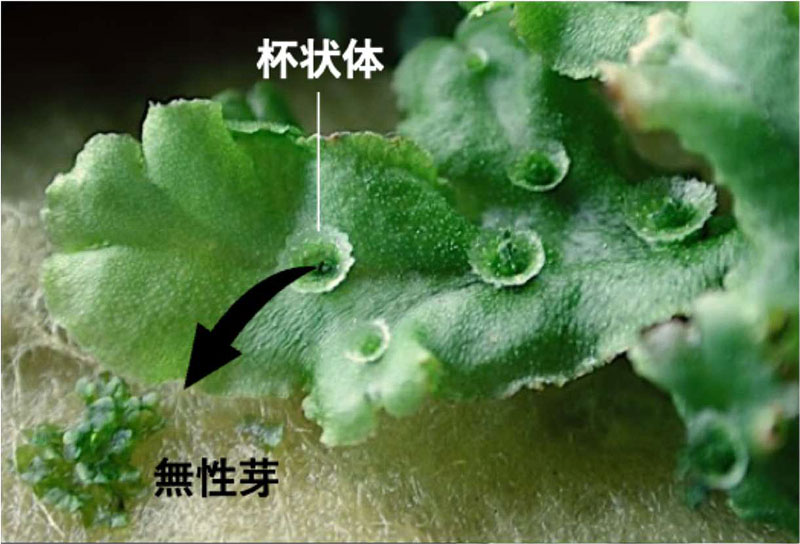
コケ植物ゼニゴケの葉状体と栄養繁殖器官(杯状体)
<関連情報>
- https://www.kyoto-u.ac.jp/ja/research-news/2025-07-30-0
- https://www.kyoto-u.ac.jp/sites/default/files/2025-07/web_2507_Yamaoka-757ee272fa962f076a81cfbad88de1eb.pdf
- https://nph.onlinelibrary.wiley.com/doi/10.1111/nph.70337
R2R3-MYB転写因子であるSHOT GLASSは、Marchantia polymorphaにおける無性芽カップと配偶子柄の発達を促進する SHOT GLASS, an R2R3-MYB transcription factor, promotes gemma cup and gametangiophore development in Marchantia polymorpha
Yuuki Sakai, Hideyuki Takami, Shohei Yamaoka, Hirotaka Kato, Hidehiro Fukaki, Takayuki Kohchi, Kimitsune Ishizaki
New Phytologist Ppublished: 29 July 2025
DOI:https://doi.org/10.1111/nph.70337
Summary
- Many plants reproduce asexually by generating clonal progeny from vegetative tissues, a process known as vegetative reproduction. This reproduction mode contrasts with sexual reproduction, which enhances genetic diversity.
- The bryophyte Marchantia polymorpha L. adjusts its reproductive strategy in response to seasonal environmental cues, transitioning between vegetative and sexual reproduction. In this study, we identified a gene encoding the R2R3-MYB transcription factor SHOT GLASS (MpSTG) as a critical regulator of gemma cup development. MpSTG was predominantly expressed in the gemma cup, apical notch, and sexual reproductive organs (gametangiophores). MpSTG mutation resulted in the formation of abnormal shot-glass-shaped structures lacking gemmae, which replaced functional gemma cups. Additionally, MpSTG-disrupted plants failed to develop sexual reproductive organs, even under inductive conditions.
- In Arabidopsis thaliana, the MpSTG ortholog LATERAL ORGAN FUSION1 (AtLOF1) plays a pivotal role in lateral bud formation. We demonstrated that MpSTG can partially compensate for AtLOF1’s function in lateral bud formation in A. thaliana.
- Our findings suggest that MpSTG is a key regulator of vegetative and sexual reproduction in M. polymorpha, and illustrate that evolutionarily conserved developmental mechanisms may function in both the gametophyte generation of bryophytes and the sporophyte generation of angiosperms.