2025-08-01 IRCN東京大学国際高等研究所
<関連情報>
- https://ircn.jp/pressrelease/20250801_takao_hench
- https://www.pnas.org/doi/10.1073/pnas.2504172122
- https://www.sciencedirect.com/science/article/pii/S2772609625000073?via%3Dihub
乳児期の早期における全身麻酔は、視覚皮質の発達を促進する General anesthesia in early infancy accelerates visual cortical development
Laurel J. Gabard-Durnam, Sarah A. McCormick, Ellen Underwood, +8 , and Takao K. Hensch
Proceedings of the National Academy of Sciences Published:July 28, 2025
DOI:https://doi.org/10.1073/pnas.2504172122
Abstract
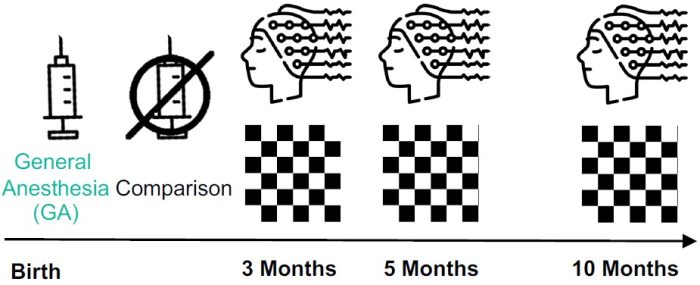
How human brain function is established through protracted trajectories of development is not yet fully understood. Maturation of γ-aminobutyric acid (GABA) circuits drives critical periods of cortical development in animal models. Whether early functional inhibition similarly impacts the pace of human brain development remains unknown. Here, in a longitudinal study of 93 infants across a range of repeated exposures to general anesthesia shortly after birth, we observed a dramatically accelerated development of visual evoked potential (VEP) waveforms (but not their latency) consistent with a conserved biological mechanism across species. Such sequelae of prolonged GABA-active anesthesia in the first half year after birth may particularly impact those at-risk of altered excitatory–inhibitory circuit balance.
乳児期の早期かつ長期的な麻酔後の10ヶ月と2~3歳時の神経発達:全身麻酔と脳活動研究(GABA)の二次分析 Neurodevelopment at 10 months and 2–3 years old after early and prolonged anaesthesia in infancy: General Anaesthesia & Brain Activity study (GABA) secondary analysis
Laura Cornelissen, Siobhan Coffman, Isabelle Kim, Ellen Underwood, Alice Tao, Maria G. Maloney, Carolina Donado, Kimberly Lobo, Charles A. Nelson, Takao K. Hensch, Laurel J. Gabard-Durnam, Charles B. Berde
BJA Open Available online: 10 March 2025
DOI:https://doi.org/10.1016/j.bjao.2025.100383
Abstract
Background
Effects of early and prolonged exposure to general anaesthesia on the developing brain are unclear. The study objective was to examine developmental outcomes at 10 months and 2–3 yr of age after general anaesthesia planned for >2 h in the first 2 months of life.
Methods
This is a secondary analysis of the General Anaesthesia & Brain Activity (GABA) study—a prospective, single-centre, longitudinal observational study. The final dataset included 59 children who were unexposed and 31 children who were exposed to early prolonged general anaesthesia who completed the primary outcome measure, Bayley Scales of Infant and Toddler Development-III (BSID) assessments at 10 months, at 2–3 yr old, or both. Analyses used adjusted Welch’s t-tests, linear regression, and linear mixed effects models.
Results
BSID composite scores for cognition were similar between general anaesthesia and unexposed cohorts at 10 months (Padj=0.566, standardised mean difference [SMD]=0.27) and at 2–3 yr (Padj=0.651, SMD=0.25). Motor and language scores were similar between cohorts at 10 months (motor: Padj=1, SMD=0.13; language: Padj=0.806, SMD=0.19) and fell within typical reference ranges. Linear regression analysis found no association between BSID cognition scores and cumulative hours of general anaesthesia at 10 months (R=0.06, P=0.635) or at 2–3 yr (R=-0.13, P=0.293).
Conclusions
Children with early prolonged general anaesthesia showed BSID scores comparable to age-matched controls. This analysis provides additional preliminary support for the safety of general anaesthesia on the developing brain even when general anaesthesia is prolonged, repeated, or administered very early in life.