2025-08-05 京都大学 iPS細胞研究所
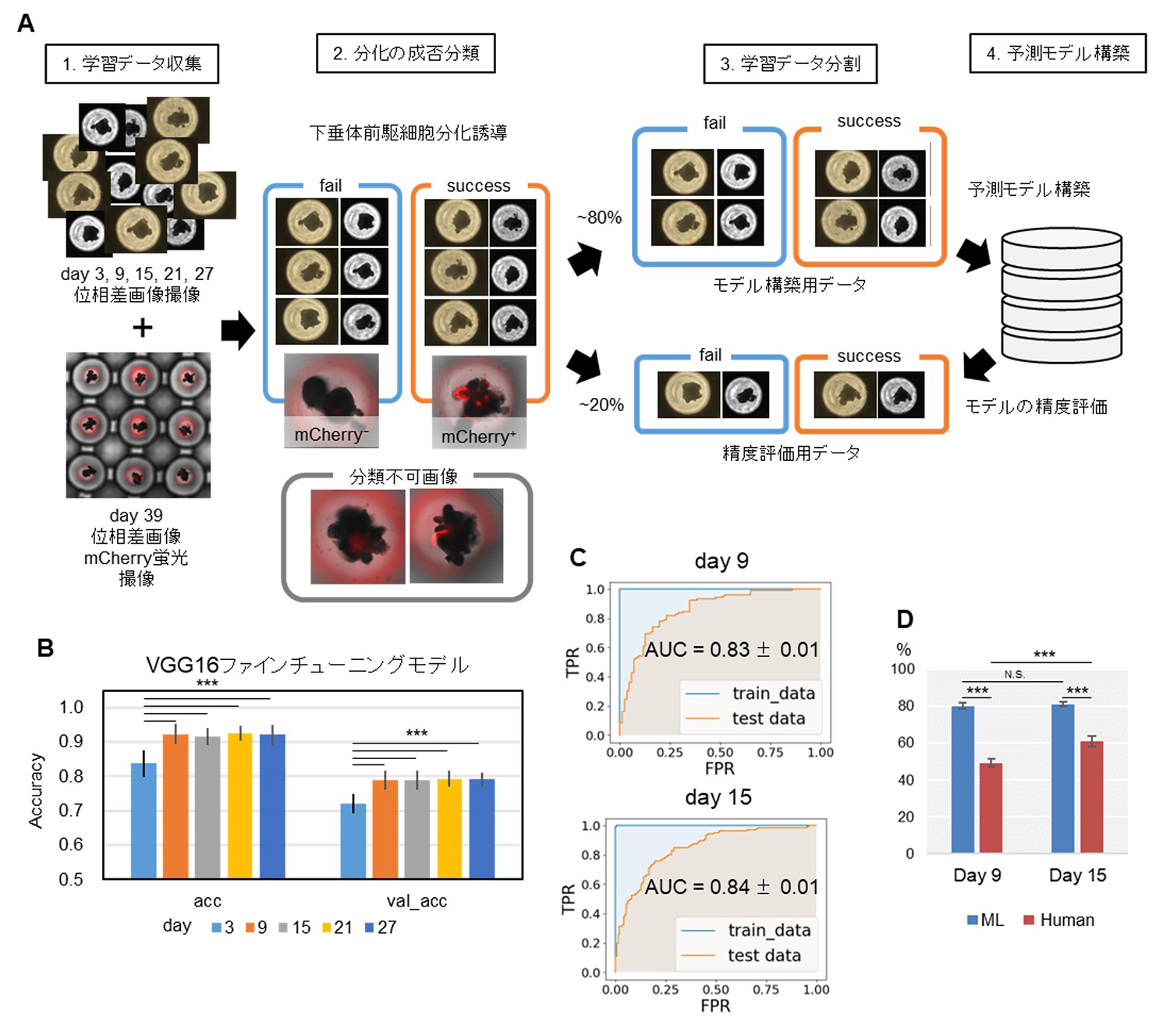 図1:下垂体オルガノイド形成予測モデルの構築とその予測精度
A. 予測モデル構築の手順
B. VGG16のファインチューニングによる予測モデルの予測精度. acc: モデル構築用データに対する予測精度. val_acc: 精度測定用データに対する予測精度
C. 培養9日目、15日目の画像データに基づくAUC曲線
D. 機械学習モデルと熟練した実験者による予測精度の比較
<関連情報>
- https://www.cira.kyoto-u.ac.jp/j/pressrelease/news/250805-000000.html
- https://www.cell.com/cell-reports-methods/fulltext/S2667-2375(25)00155-9
機械学習を用いた下垂体-視床下部オルガノイド形成の予測 Prediction of the hypothalamus-pituitary organoid formation using machine learning
Ryusaku Matsumoto ∙ Hidetaka Suga ∙ Yutaka Takahashi ∙ Takashi Aoi ∙ Takuya Yamamoto
Cell Reports Methods Published:August 4, 2025
DOI:https://doi.org/10.1016/j.crmeth.2025.101119
Motivation
Organoid induction methods from pluripotent stem cells typically involve prolonged culture periods and often suffer from unstable induction efficiency, which hinders experimental productivity and widespread application. To address these problems, we developed a machine learning-based model capable of predicting the induction efficiency of the hypothalamus-pituitary organoids using only phase-contrast images of the early stages of their differentiation.
Highlights
- Machine learning model can predict pituitary organoid formation from phase images
- The model outperforms human researchers and can be applied to other cell lines
- The model makes predictions based on morphological features of the organoid surface
- The morphological change mirrors the cellular localization pattern within the organoid
Summary
Multi-cellular organoids are self-assembly aggregates that mimic biological functions and developmental processes of many tissue types in vitro. They are widely employed for disease modeling and functional studies. Hypothalamus-pituitary organoids can be generated through differentiation induction from pluripotent stem cells. However, their maturation is time consuming and labor intensive, and the quality of the resulting organoids can vary. Here, we developed a machine learning model capable of accurately predicting the successful generation of high-quality hypothalamus-pituitary organoids based solely on phase-contrast images captured during the early stage of differentiation. The model achieved an accuracy of 79% using images from organoids on day 9 to predict pituitary cell differentiation at day 40. Moreover, the computational approach identified the shape of the organoid surface as a critical determining factor that significantly affected the prediction. This model can help to enhance the efficiency of organoid induction experiments and illuminate the molecular mechanisms involved in hypothalamus-pituitary differentiation.