2025-07-28 中国科学院(CAS)
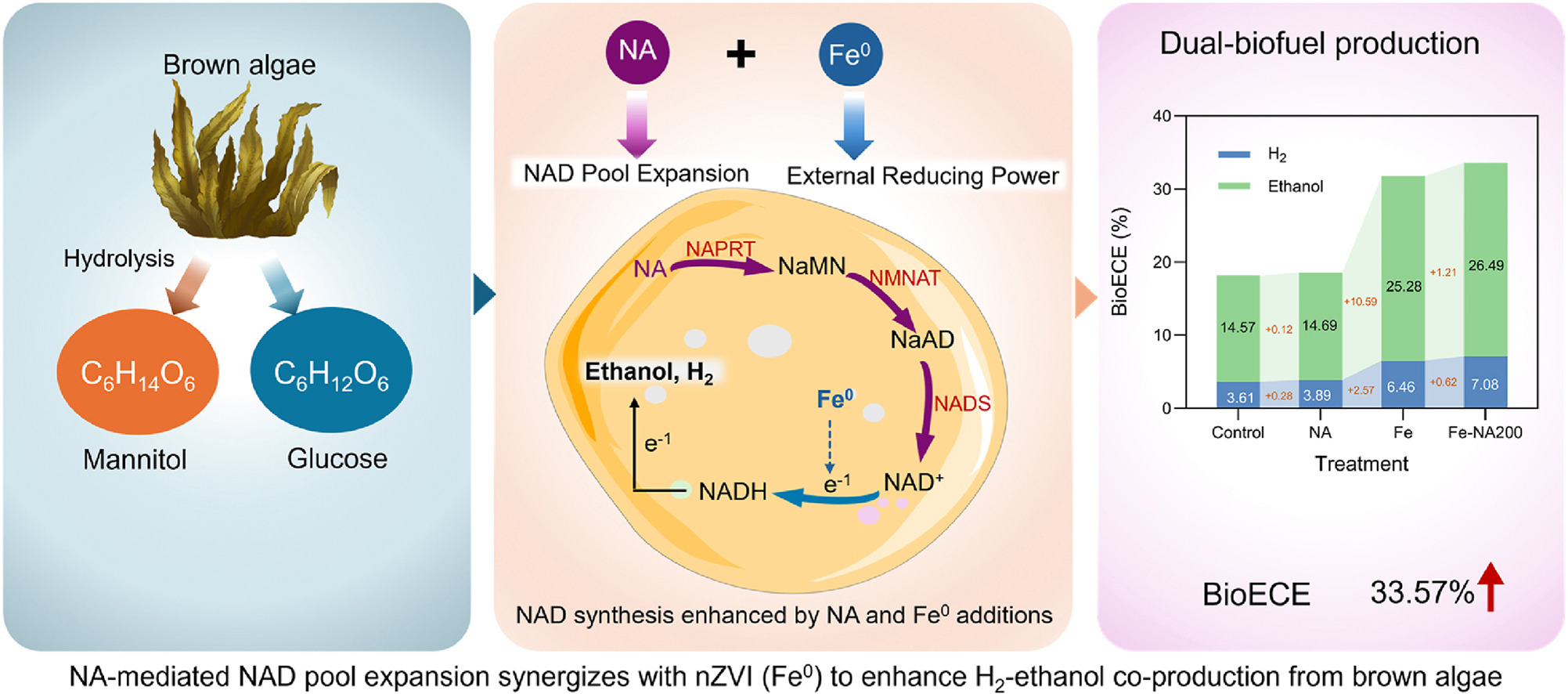
Nicotinic acid (NA) expands the electron carrier pool while nano zero-valent iron (nZVI) provides external electrons, synergistically enhancing hydrogen and ethanol production from brown algae. (Image by LI Weiming et al.)
<関連情報>
- https://english.cas.cn/newsroom/research_news/earth/202507/t20250729_1048658.shtml
- https://www.sciencedirect.com/science/article/abs/pii/S0360319925035748?via%3Dihub
ニコチン酸を介したNADプール拡大により、褐藻から水素とエタノールの相乗的共生産を解き放つ Unlocking synergistic hydrogen-ethanol co-production from brown algae through nicotinic acid-mediated NAD pool expansion
Weiming Li, Mengyang Bian, Can Jin, Xiangfeng Zeng, Yongfeng Jia
International Journal of Hydrogen Energy Available online: 22 July 2025
DOI:https://doi.org/10.1016/j.ijhydene.2025.150575
Highlights
- NA upregulated NAD synthetic genes and expanded NAD pool in fermentation bacteria.
- Nano Fe0 provides external electrons and its co-addition with NA increased NADH level.
- NA showed synergistic effects with Fe0, increasing H2 by 84.05 % and ethanol by 81.98 %.
- Optimal NA-Fe0 combination achieved 33.57 % bioenergy conversion from brown algae.
- NA’s effect was more pronounced in glucose than mannitol fermentation.
Abstract
NAD (NAD+ and NADH) serve as the critical redox cofactor mediating electron transfer in dark fermentation. This study demonstrates how nicotinic acid (NA)-mediated NAD pool expansion can be used as a key to unlock synergistic enhancement in this process. While NA supplementation alone provided only modest gains in the primary mannitol-based system, its role in enabling synergy was confirmed when combined with an external electron donor (nano zero-valent iron, nZVI). The optimal combination (200 mg/L NA with 100 mg/L nZVI) enhanced hydrogen production by 84.05 % (2.51 mol H2/mol-mannitol) and ethanol production by 81.98 % (4.04 g/L). NA’s promoting effect was more significant in glucose fermentation than in mannitol fermentation, indicating substrate reduction degree influences NA effectiveness. Mechanistic studies revealed that NA upregulated NAD synthetic genes and increased the intracellular NAD pool. Enhanced NADH generation and lowered redox potential facilitated the activities of hydrogenase and alcohol dehydrogenase. This approach achieved 33.57 % bioenergy conversion efficiency, representing a promising strategy for improving biofuel production from marine biomass.