2025-08-20 京都大学iPS細胞研究所
<関連情報>
- https://www.cira.kyoto-u.ac.jp/j/pressrelease/news/250820-000000.html
- https://www.sciencedirect.com/science/article/pii/S1934590925002693?via%3Dihub
パーキンソン病を対象としたiPS細胞ベースの同種細胞療法臨床試験における免疫応答の制御 Control of immune response in an iPSC-based allogeneic cell therapy clinical trial for Parkinson’s disease
Asuka Morizane, Emi Yamasaki, Takero Shindo, Takayuki Anazawa, Nobukatsu Sawamoto, Atsushi Shima, Hodaka Yamakado, Etsuro Nakanishi, Masanori Sawamura, Yosuke Taruno, Daisuke Doi, Tetsuhiro Kikuchi, Yuri Kawasaki, Megumu K. Saito, Takayuki Kikuchi, Yoshiki Arakawa, Susumu Miyamoto, Yuji Nakamoto, Ryosuke Takahashi, Jun Takahashi
Cell Stem Cell Available online 19 August 2025
DOI:https://doi.org/10.1016/j.stem.2025.07.012
Highlights
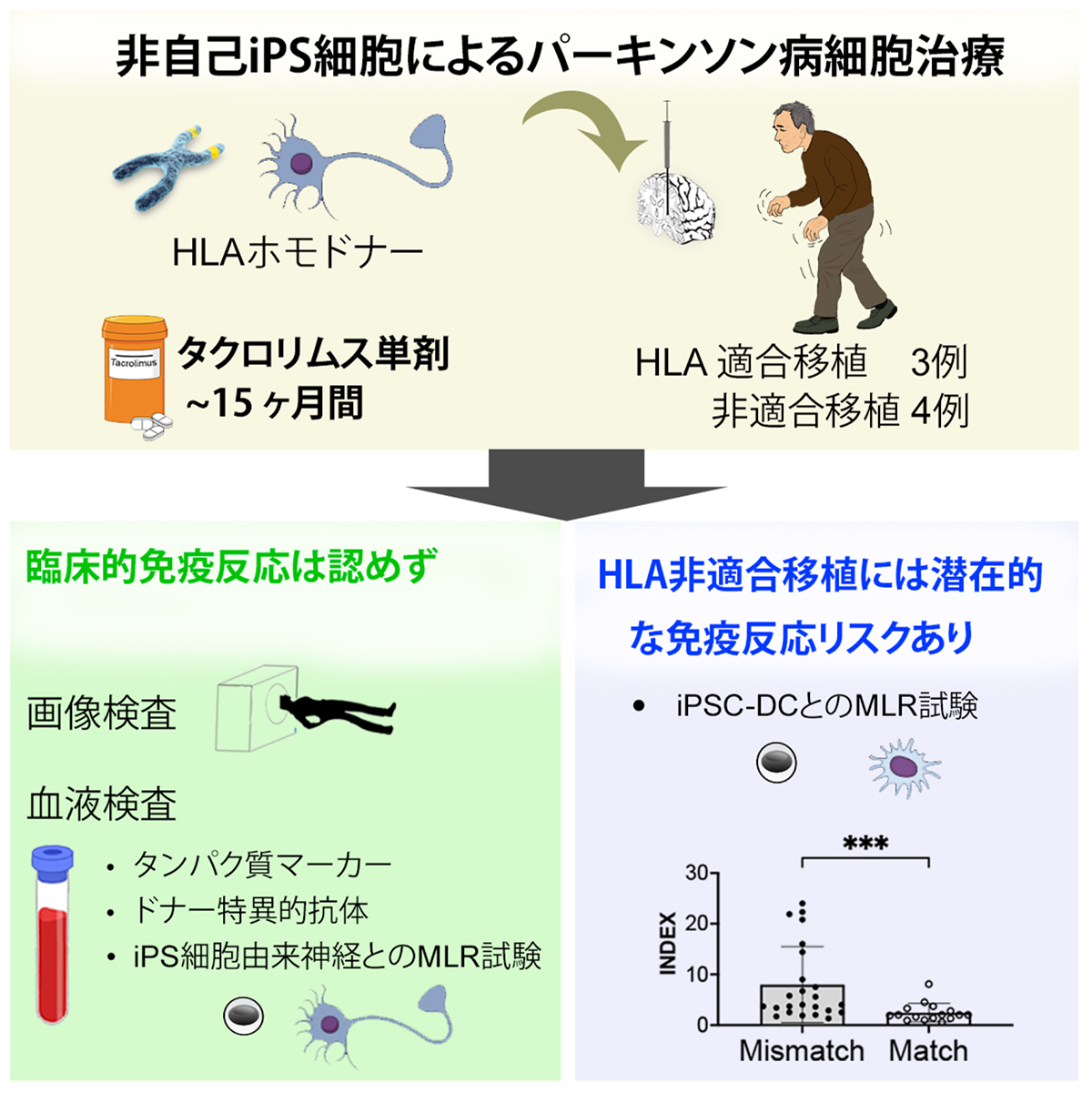
- Tacrolimus alone was used for immunosuppression in the trial
- No clinical immune reaction was observed, regardless of HLA compatibility
- Conventional immunosuppression may be reduced in CNS stem cell therapies
- MLR using iPSC-dendritic cells (DCs) indicated a higher risk in HLA mismatch
Summary
Because the central nervous system (CNS) is an immune-privileged organ, it requires different immunosuppression strategies for cell therapies using induced pluripotent stem cells (iPSCs) compared with ones for organ transplantations. We recently conducted the first in-human clinical trial of a cell therapy for Parkinson’s disease using allogeneic iPSCs (jRCT number: jRCT2090220384). All patients were transplanted with dopaminergic neural progenitors differentiated from iPSCs (iPSC-DANs), which had homozygous human leukocyte antigen (HLA) haplotypes, through immunosuppression with tacrolimus alone. No clinically significant immune reaction was observed in this study, regardless of HLA compatibility. However, a highly sensitive mixed lymphocyte reaction using iPSC-derived dendritic cells as a stimulator demonstrated the activation of lymphocytes from HLA-mismatch-grafted recipients. This finding suggests that the low expression of HLA in iPSC-DANs contributes to successful engraftment in the immune-privileged CNS. These results indicate that only moderate immunosuppressive treatment may be required for stem cell transplantation to the CNS.