2025-08-21 東北大学
<関連情報>
- https://www.tohoku.ac.jp/japanese/2025/08/press20250821-02-RNA.html
- https://www.tohoku.ac.jp/japanese/newimg/pressimg/tohokuuniv-press20250821_02web_RNA.pdf
- https://www.cell.com/cell/fulltext/S0092-8674(25)00863-3
アデノシンキナーゼとADALは、代謝を保護するために修飾されたアデノシンの解毒を協調して行う Adenosine kinase and ADAL coordinate detoxification of modified adenosines to safeguard metabolism
Akiko Ogawa ∙ Satoshi Watanabe ∙ Iuliia Ozerova ∙ … ∙ Shinichiro Sawa ∙ Kenji Inaba ∙ Fan-Yan Wei
Cell Published:August 20, 2025
DOI:https://doi.org/10.1016/j.cell.2025.07.041
Highlights
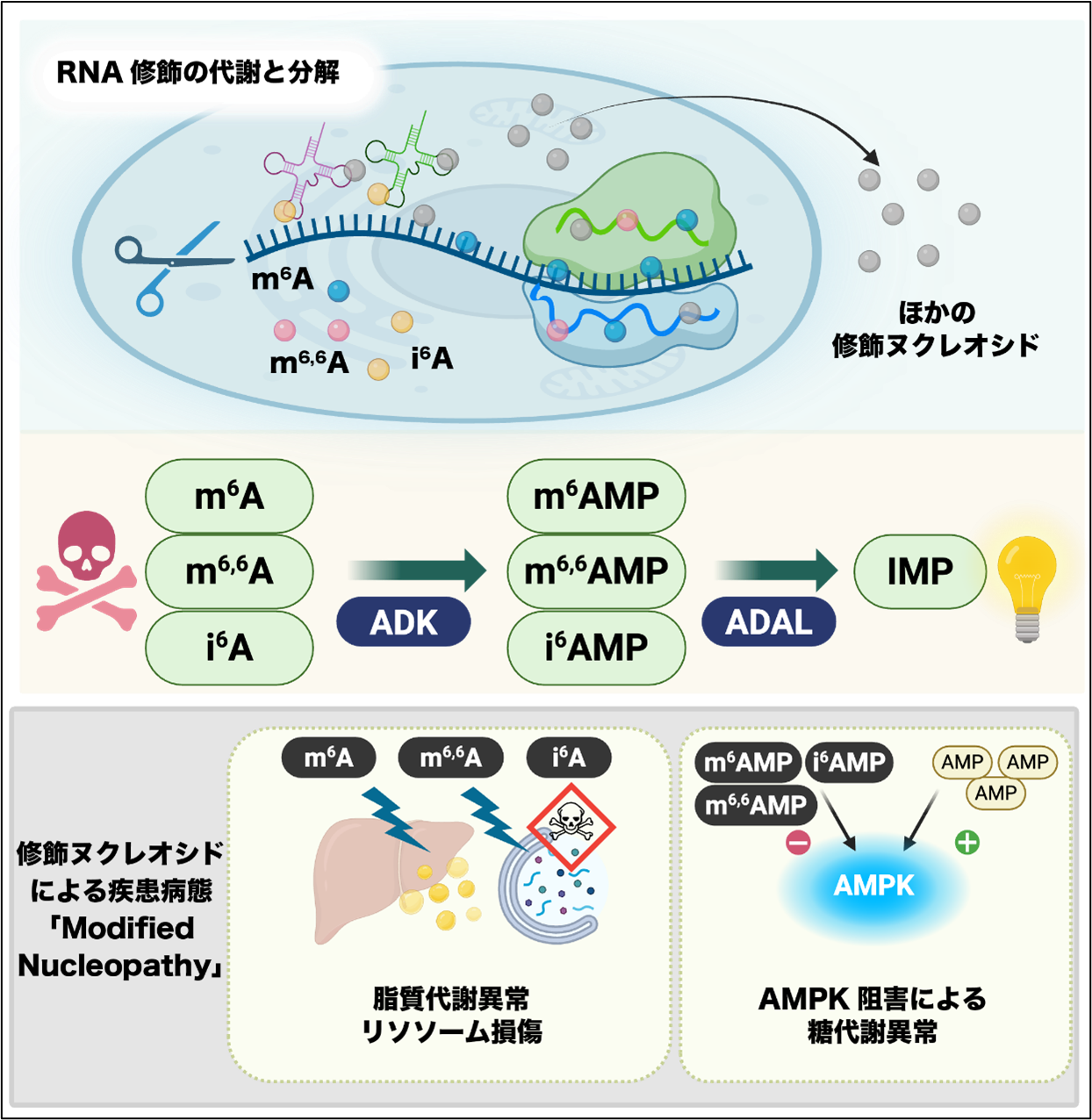
- m6A, m6,6A, and i6A are toxic nucleosides metabolized by ADK and ADAL into IMP
- ADK deficiency drives lethal accumulation of m6A, m6,6A, and i6A in mice
- m6AMP, m6,6AMP, and i6AMP buildup by ADAL inhibits AMPK, impairing glucose tolerance
- Modified adenosines disrupt lysosomes, linking toxicity with lipid dysregulation
Summary
RNA contains diverse post-transcriptional modifications, and its catabolic breakdown yields numerous modified nucleosides requiring correct processing, but the mechanisms remain unknown. Here, we demonstrate that three RNA-derived modified adenosines, N6-methyladenosine (m6A), N6,N6-dimethyladenosine (m6,6A), and N6-isopentenyladenosine (i6A), are sequentially metabolized into inosine monophosphate (IMP) to mitigate their intrinsic cytotoxicity. After phosphorylation by adenosine kinase (ADK), they undergo deamination by adenosine deaminase-like (ADAL). In Adal knockout mice, N6-modified adenosine monophosphates (AMPs) accumulate and allosterically inhibit AMP-activated protein kinase (AMPK), dysregulating glucose metabolism. Furthermore, ADK deficiency, linked to human inherited disorders of purine metabolism, elevates levels of the three modified adenosines, resulting in early lethality in mice. Mechanistically, excessive m6A, m6,6A, and i6A impair lysosomal function by interfering with lysosomal membrane proteins, thereby disrupting lipid metabolism and causing cellular toxicity. Through this nucleotide metabolism pathway and mechanism, cells detoxify modified adenosines, linking modified RNA metabolism to human disease.