2025-08-20 基礎生物学研究所
自然科学研究機構 基礎生物学研究所の研究チームは、植物の光ストレス応答とゲノム可塑性を繋ぐ新しい分子メカニズムを発見しました。クラミドモナスのDET1遺伝子が欠損した変異株では、光防御遺伝子LHCSRが過剰に発現し、弱光下で成長が阻害されますが、時間が経つとDNAトランスポゾン「Bill」がLHCSR転写因子に挿入されることでNPQ反応が抑制され、成長が回復する現象が確認されました。これはDET1が通常、光合成光防御反応とトランスポゾン活性化を同時に抑制しており、短期的な光ストレス応答と長期的なゲノム適応を統合的に制御していることを意味します。本研究は、生物が環境変動にどう適応し進化してきたかに新たな視点を与えるとともに、植物の耐環境性能を高める応用研究への展開が期待されます。本成果は「New Phytologist」に掲載されました。
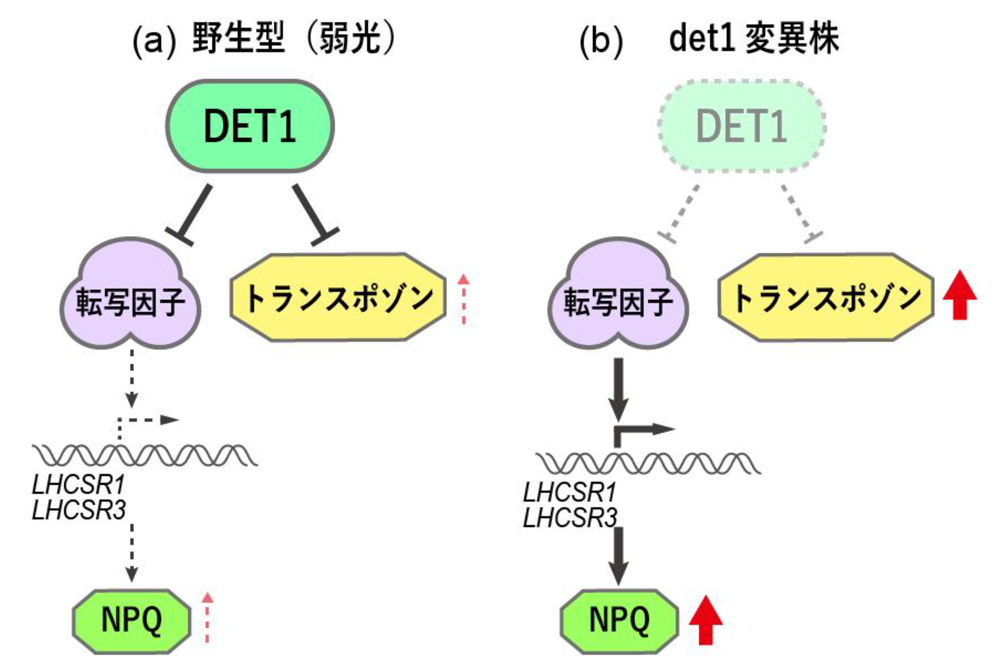 図:通常時(弱光)、野生株ではLHCSRの転写因子とトランスポゾンの活性はDET1によって抑制されていますが、DET1を欠損すると(det1変異株)、LHCSRは転写されてNPQ反応が上昇するとともに、トランスポゾンの抑制が解除されます。
<関連情報>
- https://www.nibb.ac.jp/press/2025/08/20.html
- https://nph.onlinelibrary.wiley.com/doi/10.1111/nph.70436
光保護から可塑性へ:Chlamydomonas det1変異体におけるトランスポゾン活性化 From photoprotection to plasticity: transposon activation in the Chlamydomonas det1 mutant
Konomi Fujimura-Kamada, Jun Minagawa
New Phytologist Published: 07 August 2025
DOI:https://doi.org/10.1111/nph.70436
Summary
- Transposable elements (TEs) contribute to genomic adaptation but are typically silenced to maintain genome integrity. In this study, we investigated TE activation in a Chlamydomonas reinhardtii mutant deficient in DE-ETIOLATED1 (DET1). This mutant was originally identified for its enhanced high-light tolerance due to constitutive nonphotochemical quenching (NPQ). While NPQ mitigates light-induced stress, its persistent activation compromises growth under low light (LL).
- Notably, the slow-growing det1 cultures under LL conditions rapidly reverted to a fast-growing phenotype. The recurrent emergence of fast-growing suppressor mutants indicated a previously unrecognized role of DET1 in TE suppression. To explore this possibility, we performed phenotypic, molecular, and genomic analyses, including TE insertion mapping and gene expression studies in det1 and its suppressor mutants.
- Our analysis uncovered that the phenotypic suppression resulted from the insertion of a specific TE, Bill, into the subunits for a transcription factor for the photoprotective genes LHCSR1/3, CrCO/NF-Ys. These insertions disrupted NPQ, restored efficient light harvesting, and facilitated growth in LL.
- These results suggest that DET1 integrates NPQ induction for photoprotection and TE mobilization for genomic plasticity, bridging short-term responses with long-term adaptation.