2025-09-01 慶應義塾大学医学部,東京大学大学院理学系研究科,東京科学大学
<関連情報>
- https://www.keio.ac.jp/ja/press-releases/2025/9/1/28-169127/
- https://www.keio.ac.jp/ja/press-releases/files/2025/9/1/250901-2.pdf
- https://www.nature.com/articles/s41467-025-63309-1
クローン多様性が腫瘍微小環境を形成し、転移性尿路上皮癌における免疫療法反応の差異をもたらす Clonal diversity shapes the tumour microenvironment leading to distinct immunotherapy responses in metastatic urothelial carcinoma
Takashi Kamatani,Kota Umeda,Tomohiro Iwasawa,Fuyuki Miya,Kazuhiro Matsumoto,Shuji Mikami,Kensuke Hara,Masayuki Shimoda,Yutaka Suzuki,Jo Nishino,Mamoru Kato,Kazuhiro Kakimi,Nobuyuki Tanaka,Mototsugu Oya & Tatsuhiko Tsunoda
Nature Communications Published:27 August 2025
DOI:https://doi.org/10.1038/s41467-025-63309-1
Abstract
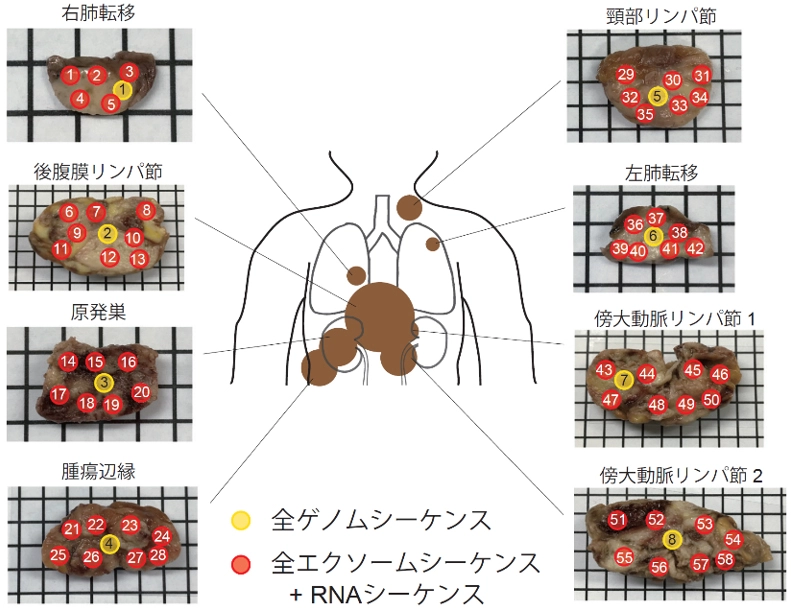
Repeated oncogenic mutations and polyclonal proliferation are evident in cancers. However, little is known about the polyclonal principles governing the systemic cancerous lineage during immunotherapy. Here, we examine a unique autopsy case of metastatic urothelial carcinoma that exhibits different treatment responses to anti-PD-1 therapy at each tumor site. By performing in-depth analyses of different multiregional bulk tumor masses, we reveal that subsets of subclones acquire potential driver mutations under treatment selection pressure. Spatial transcriptomics analysis reveals that subclones resistant to immunotherapy form distinct immunosuppressive environments consistent with their habitats. Furthermore, different cancer hallmarks are identified in each of the subclones that expand under immunotherapy at single-cell level; for example, one subclone is more proliferative, and another is more stem-cell-like. In summary, this study provides an overall picture of the polyclonal competition and changes in the immune microenvironment that are related to resistance to immunotherapy in patients with malignancies.