2025-09-02 バース大学
<関連情報>
- https://www.bath.ac.uk/announcements/early-alzheimers-brainwave-test-detects-memory-decline-years-before-diagnosis/
- https://academic.oup.com/braincomms/article/7/5/fcaf279/8244619
- https://academic.oup.com/brain/article/144/9/2812/6372384
軽度認知障害における認識記憶の受動的・客観的測定法:Fastball記憶評価法の応用 A passive and objective measure of recognition memory in mild cognitive impairment using Fastball memory assessment
George Stothart , Sophie Alderman , Oliver Hermann , Sam Creavin , Elizabeth J Coulthard
Brain Communications Published:01 September 2025
DOI:https://doi.org/10.1093/braincomms/fcaf279
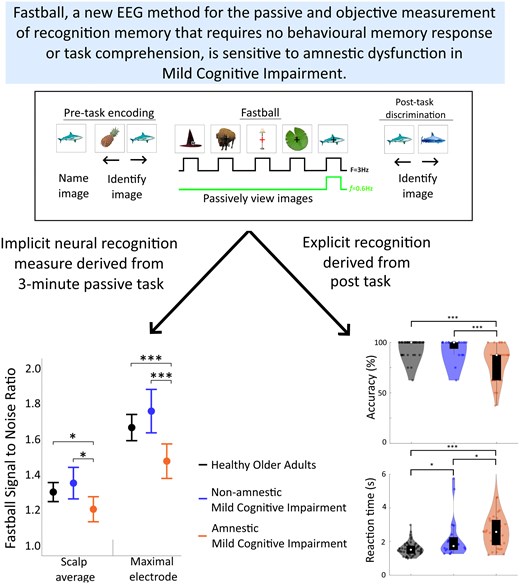
Graphical Abstract
Abstract
As viable pharmacotherapies and blood biomarkers emerge for dementia treatment and screening, there remains a great need for accurate, sensitive biomarkers of cognitive function. We have previously demonstrated that Fastball, a new Electroencephalography (EEG) method for the passive and objective measurement of recognition memory that requires no behavioural memory response or task comprehension, is sensitive to cognitive dysfunction in Alzheimer’s disease. Here we present new evidence that Fastball is sensitive to amnestic dysfunction in an earlier stage of the dementia lifecourse, Mild Cognitive Impairment (MCI). 53 MCI patients and 54 healthy older adult (HOA) controls completed a 3-min Fastball task in which they passively viewed rapidly presented images while EEG captured their automatic ability to differentiate between images based on previous exposure. They also completed neuropsychological assessments of memory (Delayed Match to Sample-48), sustained attention (Psychomotor Vigilance Task), and general cognitive function (Addenbrookes Cognitive Exam-iii). Participants were re-tested after 1 year to establish the test-retest reliability of Fastball in HOAs, and the sensitivity of Fastball to cognitive decline in MCI patients, over a 1 year period. Amnestic MCI patients showed significantly reduced Fastball responses compared with non-amnestic MCI patients (P = 0.001, Cohen’s d = 0.98) and HOA controls (P = 0.005, Cohen’s d = 0.64). Regression analyses showed that Fastball EEG responses were selectively predictive of neuropsychological measures of recognition memory and not attention. Between baseline and year one follow-up Fastball showed moderate to good test-retest reliability in HOA controls, and the six MCI-dementia converters showed a trend for lower Fastball responses at baseline which will be confirmed with further longitudinal assessment. Fastball is further validated as a viable method for testing recognition memory in cognitively impaired populations. We have demonstrated that it is selectively predictive of memory dysfunction and not attention or other cognitive functions. It is passive, non-invasive, quick to administer and uses cheap, scalable EEG technology. Fastball is a viable functional biomarker that can help to advance cognitive assessment in MCI.
アルツハイマー病における認識記憶の受動的かつ客観的測定法:Fastball記憶評価を用いたアプローチ A passive and objective measure of recognition memory in Alzheimer’s disease using Fastball memory assessment
George Stothart , Laura J Smith , Alexander Milton , Elizabeth Coulthard
Brain Published:20 September 2021
DOI:https://doi.org/10.1093/brain/awab154
Abstract
Earlier diagnosis of Alzheimer’s disease requires biomarkers sensitive to associated structural and functional changes. While considerable progress has been made in the development of structural biomarkers, functional biomarkers of early cognitive change, unconfounded by effort, practice and level of education, are still needed. We present Fastball, a new EEG method for the passive and objective measurement of recognition memory, that requires no behavioural memory response or comprehension of the task . Younger adults, older adults and Alzheimer’s disease patients (n = 20 per group) completed the Fastball task, lasting just under 3 min. Participants passively viewed rapidly presented images and EEG assessed their automatic ability to differentiate between images based on previous exposure, i.e. old/new. Participants were not instructed to attend to previously seen images and provided no behavioural response. Following the Fastball task, participants completed a two-alternative forced choice (2AFC) task to measure their explicit behavioural recognition of previously seen stimuli. Fastball EEG detected significantly impaired recognition memory in Alzheimer’s disease compared to healthy older adults (P < 0.001, Cohen’s d = 1.52), whereas behavioural recognition was not significantly different between Alzheimer’s disease and healthy older adults. Alzheimer’s disease patients could be discriminated with high accuracy from healthy older adult controls using the Fastball measure of recognition memory (AUC = 0.86, P < 0.001), whereas discrimination performance was poor using behavioural 2AFC accuracy (AUC = 0.63, P = 0.148). There were no significant effects of healthy ageing, with older and younger adult controls performing equivalently in both the Fastball task and behavioural 2AFC task. Early diagnosis of Alzheimer’s disease offers potential for early treatment when quality of life and independence can be retained through disease modification and cognitive enhancement. Fastball provides an alternative way of testing recognition responses that holds promise as a functional marker of disease pathology in stages where behavioural performance deficits are not yet evident. It is passive, non-invasive, quick to administer and uses cheap, scalable EEG technology. Fastball provides a new powerful method for the assessment of cognition in dementia and opens a new door in the development of early diagnosis tools.