2025-09-11 中国科学院(CAS)
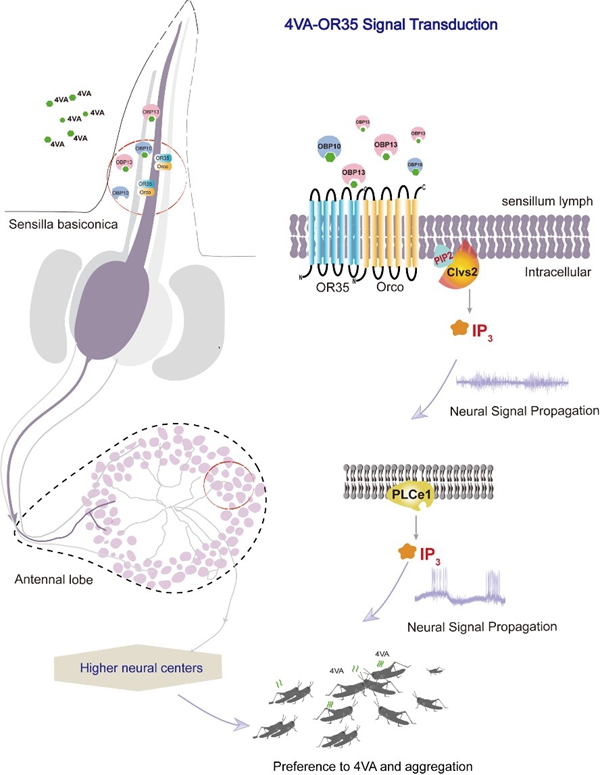
A complete olfactory transduction pathway in locusts. (Image by Prof. KANG Le’s Lab)
<関連情報>
- https://english.cas.cn/newsroom/research_news/life/202509/t20250911_1054402.shtml
- https://www.science.org/doi/10.1126/sciadv.ads1352
イナゴは嗅覚シグナル伝達におけるセカンドメッセンジャーとしてIP3を採用する Locusts adopt IP3 as a second messenger for olfactory signal transduction
Jing Yang, Helen He, Shijie Dong, Jing Lv, […] , and Xiaojiao Guo
Science Advances Published:10 Sep 2025
DOI:https://doi.org/10.1126/sciadv.ads1352
Abstract
Insects, unlike vertebrates, use heteromeric complexes of odorant receptors and co-receptors for olfactory signal transduction. However, the secondary messengers involved in this process are largely unknown. Here, we use the olfactory signal transduction of the aggregation pheromone 4-vinylanisole (4VA) as a model to address this question. When locusts detect 4VA, the pheromone is transported by OBP10 and OBP13 to the OR35–Orco receptor complex, thereby activating downstream pathways in the antenna. A pivotal downstream molecule, the lipid-binding protein Clvs2, facilitates phosphatidylinositol 4,5-bisphosphate transportation across the cytolemma, providing more substrates for inositol trisphosphate (IP3) production. PLCe1, a biosynthetic enzyme, boosts IP3 levels in the antennal lobe of the brain. IP3 is responsible for converting chemical signals from the antenna into neural signals, confirming IP3 as a secondary messenger in olfaction perception instead of GPCR in locusts. These findings elucidate the universal function of IP3 in olfactory signal perception, shedding light on the key nodes of insect olfactory signal transduction.