2025-09-08 中国科学院(CAS)
Web要約 の発言:
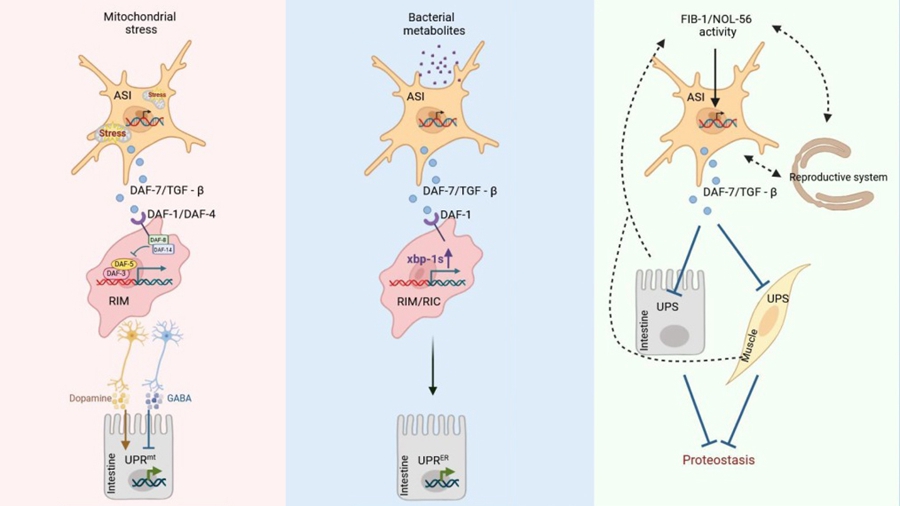 The regulation of stress response mechanisms and proteostasis signaling in Caenorhabditis elegans by transforming growth factor (TGF)-β. (Image by IGDB)
<関連情報>
- https://english.cas.cn/newsroom/research_news/life/202509/t20250909_1054302.shtml
- https://www.cell.com/trends/cell-biology/fulltext/S0962-8924(25)00176-X
TGF-βシグナル伝達経路としての生物学的プロテオスタシス調節因子 TGF-β signaling as an organismal proteostasis regulator
Huadong Zhu ∙ Qian Zhang ∙ Ye Tian ∙ Ehud Cohen
Trends in Cell Biology Published:August 29, 2025
DOI:https://doi.org/10.1016/j.tcb.2025.07.008
Highlights
The proteostasis network (PN) is a nexus of mechanisms that maintain the integrity of the proteome in different cellular organelles. The competence of the PN declines with age, exposing the organism to proteinopathies.
The PN is regulated at the organismal level by intertissue communication.
The tumor growth factor (TGF)-β signaling cascade emerges as a proteostasis-regulating pathway that is activated by mitochondrial stress, exposure to bacterial metabolites, and knockdown of the Fibrillarin complex.
In the nematode Caenorhabditis elegans, ASI neurons have crucial roles in the regulation of organismal proteostasis by governing TGF-β signaling.
Abstract
Various mechanisms act in a coordinated manner to maintain proteostasis in different cellular organelles. Nevertheless, with aging, certain proteins escape proteostasis surveillance, misfold, and aggregate. This process can lead to neurodegeneration. Despite the cellular nature of proteostasis, it is regulated by intertissue communication. How these intertissue signaling mechanisms coordinate proteostasis across the organism is largely obscure. Recent studies unveiled that the transforming growth factor (TGF)-β signaling cascade is an organismal proteostasis regulator. Here, we focus on the known roles of the TGF-β pathway as a coordinator of proteostasis and describe the messengers and biological activities that are controlled by this pathway. We also discuss open questions and highlight the potential clinical relevance of these discoveries.