
2025-09-18 中国科学院(CAS)
<関連情報>
- https://english.cas.cn/newsroom/research_news/infotech/202509/t20250915_1054637.shtml
- https://www.nature.com/articles/s41586-025-09344-w
動的生体電子工学のための可動式長期埋込型柔軟マイクロファイバー A movable long-term implantable soft microfibre for dynamic bioelectronics
Ruijie Xie,Fei Han,Qianhengyuan Yu,Dong Li,Xu Han,Xiaolong Xu,Huan Yu,Jianping Huang,Xiaomeng Zhou,Hang Zhao,Xinping Deng,Qiong Tian,Qingsong Li,Hanfei Li,Yang Zhao,Guoyao Ma,Guanglin Li,Hairong Zheng,Meifang Zhu,Wei Yan,Tiantian Xu & Zhiyuan Liu
Nature Published:17 September 2025
DOI:https://doi.org/10.1038/s41586-025-09344-w
Abstract
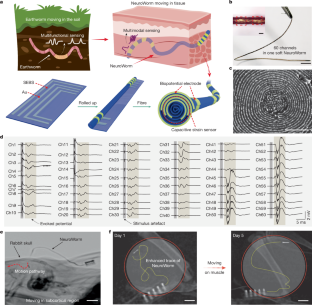
Long-term implantable bioelectronics offer a powerful means to evaluate the function of the nervous system and serve as effective human–machine interfaces1,2,3. Here, inspired by earthworms, we introduce NeuroWorm—a soft, stretchable and movable fibre sensor designed for bioelectronic interface. Our approach involves rolling to transform 2D bioelectronic devices into 1D NeuroWorm, creating a multifunctional microfibre that houses longitudinally distributed electrode arrays for both bioelectrical and biomechanical monitoring. NeuroWorm effectively records high-quality spatio-temporal signals in situ while steerably advancing within the brain or on the muscle as needed. This allows for the dynamic targeting and shifting of desired monitoring sites. Implanted in muscle through a tiny incision, NeuroWorm provides stable bioelectrical monitoring in rats for more than 43 weeks. Even after 54 weeks of implantation in muscle, fibroblast encapsulation around the fibre remains negligible. Our NeuroWorm represents a platform that promotes a substantial advance in bioelectronics—from an immobile probe fixed in place to active, intelligent and living devices for long-term, minimally invasive and mobile evaluation of the nervous system.

