2025-09-16 ジョージア工科大学
<関連情報>
- https://research.gatech.edu/meet-microbes-what-warming-wetland-reveals-about-earths-carbon-future
- https://www.nature.com/articles/s41467-025-61664-7
北方泥炭地の微生物群集は温暖化への耐性を示し、土壌有機物から電子受容体を獲得する Northern peatland microbial communities exhibit resistance to warming and acquire electron acceptors from soil organic matter
Katherine Duchesneau,Borja Aldeguer-Riquelme,Caitlin Petro,Ghiwa Makke,Madison Green,Malak Tfaily,Rachel Wilson,Spencer W. Roth,Eric R. Johnston,Laurel A. Kluber,Christopher W. Schadt,Jesse B. Trejo,Stephen J. Callister,Samuel O. Purvine,Jeffrey P. Chanton,Paul J. Hanson,Susannah Tringe,Emiley Eloe-Fadrosh,Tijana Glavina del Rio,Konstantinos T. Konstantinidis & Joel E. Kostka
Nature Communications Published:25 July 2025
DOI:https://doi.org/10.1038/s41467-025-61664-7
Abstract
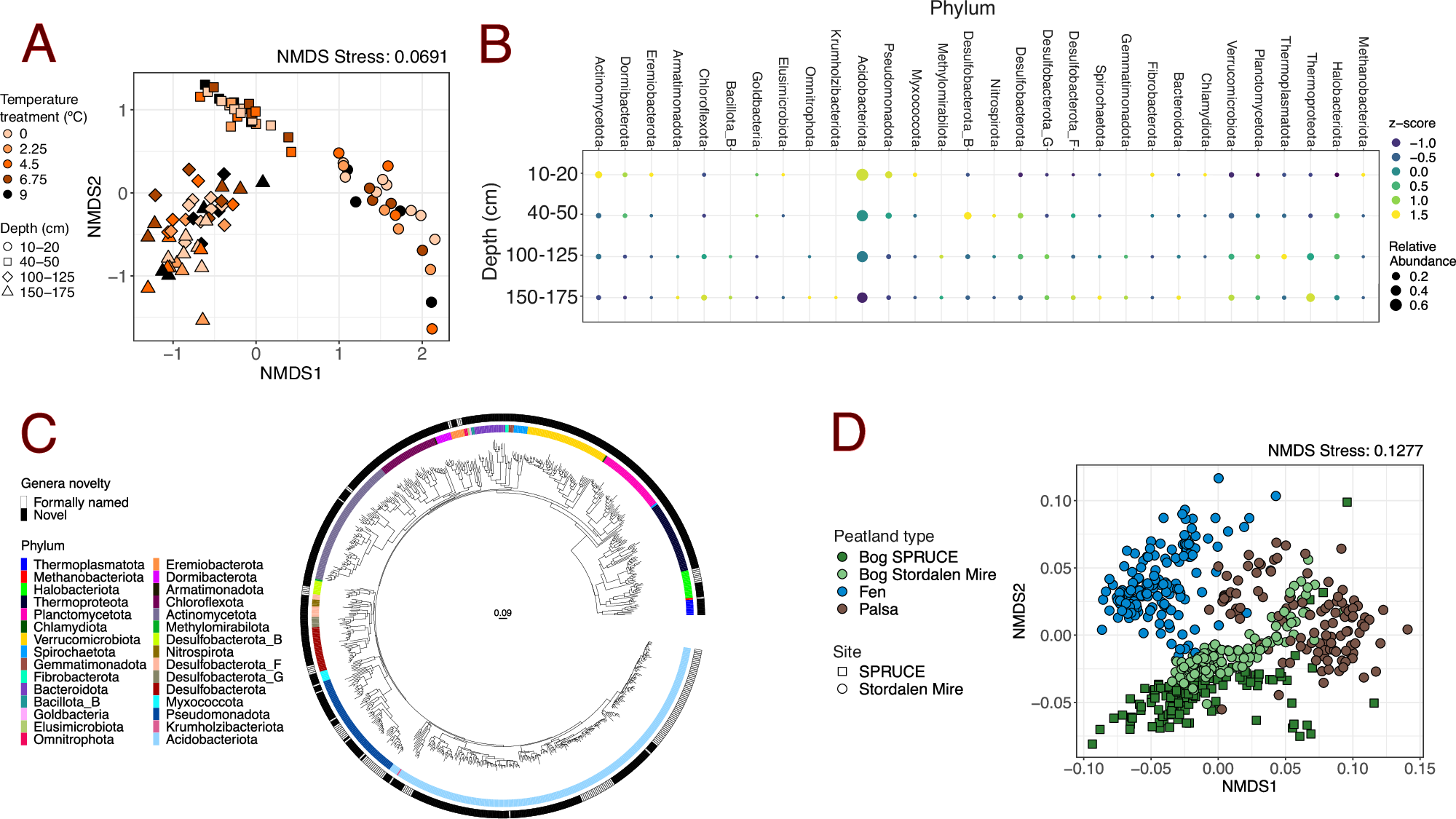
The response of microbial communities that regulate belowground carbon turnover to climate change drivers in peatlands is poorly understood. Here, we leverage a whole ecosystem warming experiment to elucidate the key processes of terminal carbon decomposition and community responses to temperature rise. Our dataset of 697 metagenome-assembled genomes (MAGs) represents the microbial community from the surface (10 cm) to 2 m deep into the peat column, with only 3.7% of genomes overlapping with other well-studied peatlands. Community composition has yet to show a significant response to warming after 3 years, suggesting that metabolically diverse soil microbial communities are resistant to climate change. Surprisingly, abundant and active methanogens in the genus Candidatus Methanoflorens, Methanobacterium, and Methanoregula show the potential for both acetoclastic and hydrogenotrophic methanogenesis. Nonetheless, the predominant pathways for anaerobic carbon decomposition include sulfate/sulfite reduction, denitrification, and acetogenesis, rather than methanogenesis based on gene abundances. Multi-omics data suggest that organic matter cleavage provides terminal electron acceptors, which together with methanogen metabolic flexibility, may explain peat microbiome composition resistance to warming.