2025-09-29 北海道大学
Web要約 の発言:
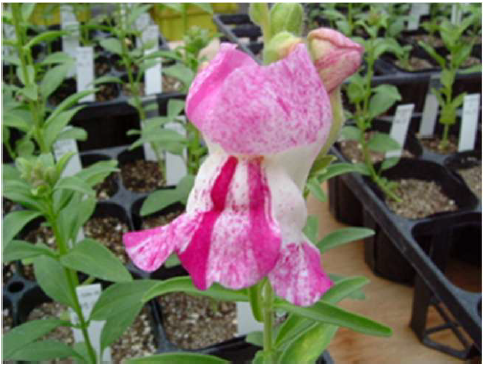
金魚草の花の斑入り模様
<関連情報>
- https://www.hokudai.ac.jp/news/2025/09/tam3.html
- https://www.hokudai.ac.jp/news/pdf/250929_pr.pdf
- https://academic.oup.com/plphys/advance-article-abstract/doi/10.1093/plphys/kiaf396/8246217
金魚草の二つのStabiliser遺伝子座はトランスポゾンTam3の転移酵素の生産を損なうことなく転移を抑える Two Stabiliser loci suppress Tam3 transposition without compromising transposase production in Antirrhinum
Shasha Wang, Takako Uchiyama, Hiroyuki Kuwabara, Megumi Hirata, Ikumi Yuasa, Kenji Nakahara, Cathie Martin, Yuji Kishima
Plant Physiology Published::02 September 2025
DOI:https://doi.org/10.1093/plphys/kiaf396
Abstract
Snapdragon (Antirrhinum majus) exhibits occasional genetic instabilities that manifest as variegations and morphological chimeras. Stabiliser (St) is a historical locus that stabilizes phenotypically unstable or mutable traits in Antirrhinum. Here, we characterized two St loci, the previously described Old Stabiliser (OSt) and New Stabiliser (NSt), that specifically suppress the transposition of the Class II DNA transposable element Tam3 in Antirrhinum. Both St loci harbor Tam3 derivatives with unique structures: OSt contains a pseudo-Tam3 copy whose 5′-terminal region has been rearranged compared to the cognate Tam3 element, and NSt consists of two intact Tam3 copies in a head-to-head orientation. Neither locus interferes with the production of the intact Tam3 transposase (TPase) or the nuclear import of TPase. Both OSt and NSt produce specific sRNAs from their 5′-terminal regions containing multiple TPase-binding motifs. We performed sRNA induction experiments by TRV-mediated virus-induced gene silencing targeting the 5’-terminal region of the Tam3 sequence, which suppressed Tam3 transposition in the ost/nst plants. These results suggest that specific sRNAs can repress Tam3 transposition by interacting with the TPase-binding motifs within the Tam3 element or with the TPase itself.