2025-10-09 成育医療研究センター
Web要約 の発言:
<関連情報>
- https://www.ncchd.go.jp/press/2025/1009.html
- https://www.ncchd.go.jp/press/assets/1009.pdf
- https://onlinelibrary.wiley.com/doi/10.1111/all.70064
アレルギー研究における患者と一般市民の関与とエンゲージメントの探究:日本における疾患横断的・利害関係者横断的な視点 Exploring Patient and Public Involvement and Engagement in Allergy Research: Cross-Disease and Cross-Stakeholder Perspectives in Japan
Takeya Adachi, Saori Watanabe, Yu Kuwabara, Yuki Abe, Masaki Futamura, Takenori Inomata, Keima Ito, Meiko Kimura, Keiko Kan-o …
Allergy Published: 18 September 2025
DOI:https://doi.org/10.1111/all.70064
To the Editor,
The 2024 Revision of the Declaration of Helsinki emphasizes the ethical importance of patient and public involvement and engagement (PPIE) to ensure medical research and care reflect participants’ needs and values. In immunological and allergic diseases, PPIE has driven initiatives ranging from basic research to patient care. Studies show involving stakeholders, such as patients and families, in treatment decisions and protocol development improves allergy therapy adherence and outcomes [1, 2].
In Japan, the Basic Act on Allergy Disease Measures enacted in 2015 led to the Strategic Outlook toward 2030: Japan’s Research for Allergy and Immunology, highlighting the importance of PPIE. It noted that integrating patient perspectives into clinical trial design could enhance research quality and efficiency [3, 4]. Yet, systematic PPIE evaluations in allergic diseases in Japan remain limited, and identifying barriers is key to shaping future strategies and ongoing national initiatives.
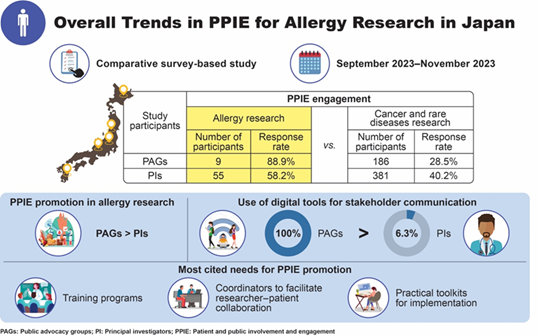
This study examined trends in PPIE within allergic diseases in Japan. Between September and November 2023, we surveyed principal investigators (PIs) from the Japan Agency for Medical Research and Development (AMED) allergy research program and representatives from patient advocacy groups (PAGs) involved in Ministry of Health, Labour and Welfare of Japan (MHLW) Allergy-Related Review Meetings (Table 1). This survey, approved by the Institutional Review Board of the National Center for Child Health and Development (#2023-078), replicated questions from previous AMED surveys on rare/intractable diseases and cancer for comparison (Appendix S1) [5].