
2025-10-07 ユニバーシティ・カレッジ・ロンドン(UCL)
<関連情報>
- https://www.ucl.ac.uk/news/2025/oct/new-drug-combination-offers-hope-men-advanced-prostate-cancer
- https://www.nature.com/articles/s41591-025-03961-8
HRR欠損転移性去勢感受性前立腺癌に対するニラパリブ、アビラテロン酢酸塩およびプレドニゾンの併用:ランダム化第3相試験 Niraparib and abiraterone acetate plus prednisone for HRR-deficient metastatic castration-sensitive prostate cancer: a randomized phase 3 trial
Gerhardt Attard,Neeraj Agarwal,Julie N. Graff,Shahneen Sandhu,Eleni Efstathiou,Mustafa Özgüroğlu,Andrea J. Pereira de Santana Gomes,Karina Vianna,Hong Luo,Geoffrey T. Gotto,Heather H. Cheng,Won Kim,Carly R. Varela,Daneen Schaeffer,Kassie Kramer,Susan Li,Benoit Baron,Fei Shen,Suneel D. Mundle,Sharon A. McCarthy,David Olmos,Kim N. Chi & Dana E. Rathkopf
Nature Medicine Published:07 October 2025
DOI:https://doi.org/10.1038/s41591-025-03961-8
Abstract
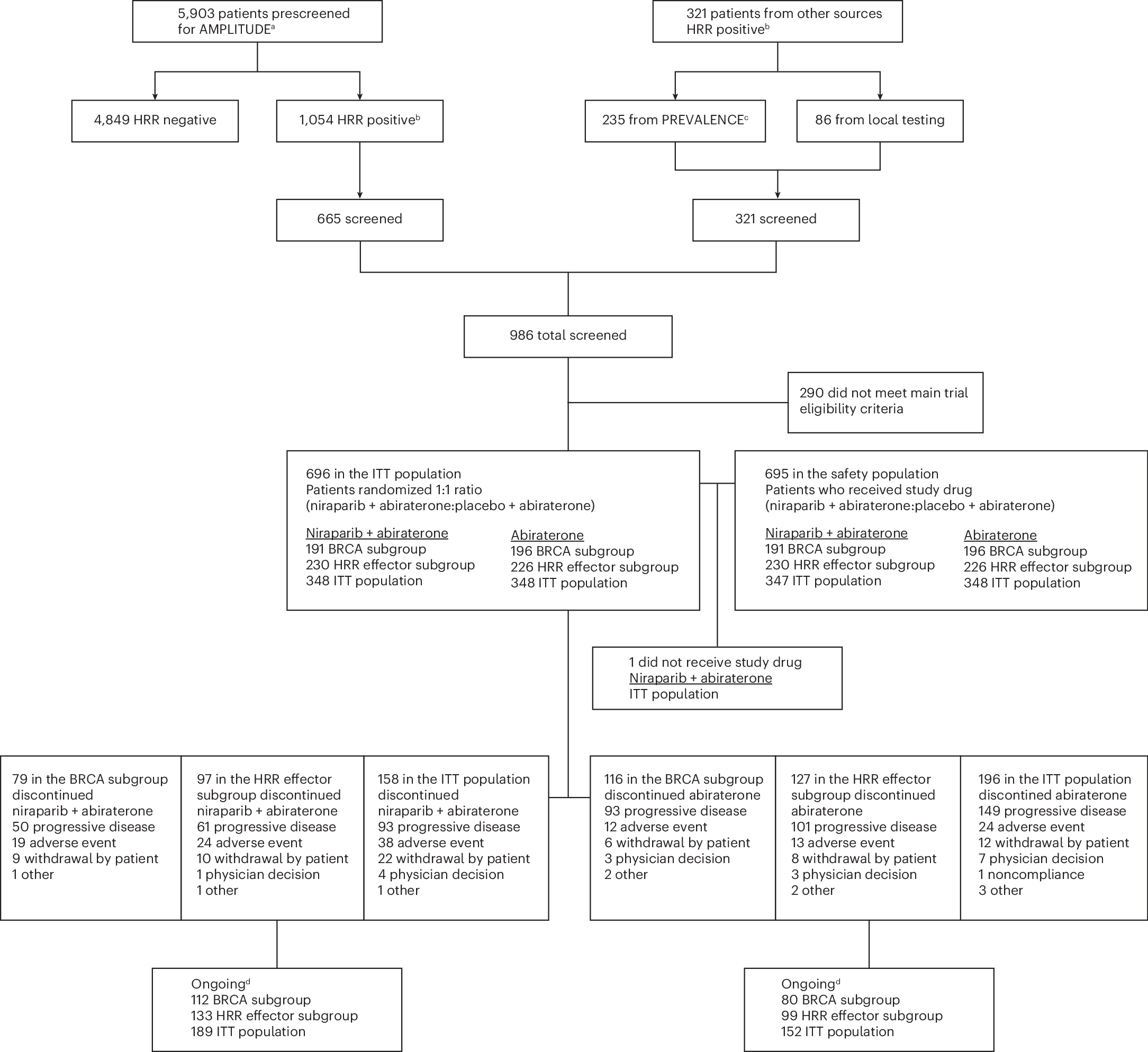
Inhibition of poly(ADP-ribose) polymerase (PARP) after relapse on hormone therapy is well established for patients with prostate cancer with homologous recombination repair (HRR) gene alterations, but resistance often develops. We hypothesized that PARP inhibition within 6 months of starting androgen deprivation therapy for metastatic castration-sensitive prostate cancer (mCSPC) could be effective and improve radiographic progression-free survival when added to standard-of-care treatments. The double-blind AMPLITUDE trial evaluated combining niraparib, a potent and specific PARP inhibitor, with abiraterone acetate and prednisone (AAP) versus placebo and AAP in mCSPC with HRR gene alterations. Patients (n = 696) were randomized in a 1:1 ratio (348 per group). Median age was 68 years; 56% had BRCA1 or BRCA2 alterations; 78% had high-volume metastases; and 16% had received docetaxel. The primary endpoint was met, with a significant improvement in radiographic progression-free survival observed first in the BRCA subgroup (median not reached at the time of analysis for the niraparib and AAP group versus 26 months for the AAP group; hazard ratio = 0.52; 95% confidence interval: 0.37–0.72; P < 0.0001) and then in the intention-to-treat population (hazard ratio = 0.63; 95% confidence interval: 0.49–0.80; P = 0.0001). The data for overall survival, a key secondary endpoint, are immature (193/389 events) but favor niraparib (hazard ratio = 0.79 (95% confidence interval: 0.59–1.04); BRCA subgroup: hazard ratio = 0.75 (95% confidence interval: 0.51–1.11)). Incidence of grade 3 or 4 adverse events was 75% in the niraparib and AAP group and 59% in the AAP group; most frequent in the niraparib and AAP group were anemia (29%), with 25% of patients requiring a blood transfusion, and hypertension (27%). There were 14 treatment-emergent adverse events leading to deaths in the niraparib group and seven in the placebo group. Combining niraparib with AAP significantly improved radiographic progression-free survival in patients with mCSPC harboring BRCA1/BRCA2 or other HRR gene alterations, suggesting clinical benefit with this combination for these patients. ClinicalTrials.gov identifier: NCT04497844.

