2025-10-22 ニューヨーク大学(NYU)
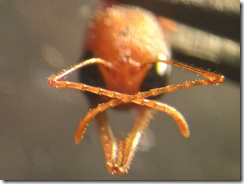
The head of an Indian jumping ant (Harpegnathos saltator) with antennae in the front. Photo credit: Bogdan Sieriebriennikov, Olena Kolumba
<関連情報>
- https://www.nyu.edu/about/news-publications/news/2025/october/ants-genetic-bulldozer-smell.html
- https://www.nature.com/articles/s41586-025-09664-x
転写干渉により、アリのニューロンごとに1つの嗅覚受容体が確保される Transcriptional interferences ensure one olfactory receptor per ant neuron
Bogdan Sieriebriennikov,Olena Kolumba,Aurore de Beaurepaire,Jennifer Wu,Valentina Fambri,Eva Bardol,Yuwei Zhong,Ildar Gainetdinov,Danny Reinberg,Hua Yan & Claude Desplan
Nature Published:22 October 2025
DOI:https://doi.org/10.1038/s41586-025-09664-x
Abstract
To ensure specificity, sensory neurons must select and express a single receptor from often vast gene families, adhering to the rule of ‘one receptor per neuron’. For example, each olfactory sensory neuron in mammals expresses only one odorant receptor (Or) gene1,2. In Drosophila, which has about 60 Or genes, this selection is deterministic3. By contrast, mice face the challenge of choosing one Or gene from over 1,000 options4. They solve this through a complex system of stochastic choices5,6,7,8,9. Ants also possess many Or genes, most of which are organized into tandem arrays similar to those in mammals, but their regulatory mechanisms have evolved independently. Here we show that, in the ant Harpegnathos saltator, each olfactory sensory neuron activates a single promoter within an Or gene array, producing a mature capped and polyadenylated mRNA. While the promoters of downstream genes in the array are inactive, all downstream genes are nonetheless transcribed due to transcriptional readthrough from the active promoter, probably caused by inefficient RNA polymerase II termination. This readthrough appears to suppress downstream promoters through transcriptional interference, resulting in aberrant non-capped transcripts that are not translated, ensuring that only the active gene is expressed. Simultaneously, long antisense transcription originating from the chosen Or promoter covers upstream genes, presumably silencing them. Ants therefore appear to have evolved a unique transcriptional-interference-based mechanism to express a single OR protein from an array of Or genes with functionally similar promoters.